Showing posts with label opera. Show all posts

Thursday, April 30, 2020

La Boheme--Scene Design

Curtain Call with Proscenium

La Boheme, an opera in four acts was composed by Giacomo Puccini, libretto by Luigi Illica and Giuseppe Giacosa, based on the novel Scènes de la vie de bohème by Henri Murger was produced in Winter Semester, 2015 In the Snow Drama Theatre at Brigham Young University-Idaho.

Synopsis
Act I:  The Garrett Apartment
Rodolfo, Marcello, Colline and Schaunard are young, struggling Bohemians who share a flat in the Montmartre District in Paris during the Art Nouveau period.  Rodolfo is burning the pages of his manuscript in the stove for warmth.  Schaunard arrives with money because he has just received a commission from a rich eccentric who paid him to play his violin until his parrot died.

Benoit, the landlord arrives and demands the rent.  As they prepare to pay him the rent, the Bohemians ply him with wine and get him drunk.  Benoit becomes talkative in his tipsy state and talks about his mistress and then admits he is married.  The boys, in mock indignation blackmail him for the rent money and threaten to tell his wife about the mistress.  Benoit leaves in humiliation and defeat.

Schaunard suggests that they all use the rent money to join him at Cafe Momus to celebrate their good fortune.  All leave except Rodolfo.  As he is preparing to leave, he hears a knock at the door and Mimi, a girl who also lives in the building it there.  Her candle has gone out and she has no matches.  He helps her and they both realize they have fallen in love.

Act II:  Cafe Momus in the Montmartre District
The scene starts out on the street in front of Cafe Momus where a great crowd has gathered.  Everybody is buying and selling and watching street performers.  Our gang enters Cafe Momus and orders food.  Musetta, Marcello's ex-girlfriend arrives with her Sugar Daddy who is a government minister.  It is clear she is tired of her wealthy boyfriend.  She torments the boyfriend by singing a very risque song in front of the crowd.  On the one hand, she is tormenting her lover and on the other, she is trying to get Marcello's attention.

After the song, she gets rid of Alcindoro, the sugar daddy, by telling him her shoe is too tight and asks him to take it to the shoemaker to have it stretched a bit.  He leaves and she joins up with Marcello and the gang.

When they are ready to leave, Schaunard discovers that his purse is gone and they have no way to pay for the meal.  Such is the life for young Bohemians.  Musetta hatches a plan and tells the head waiter to give the bill to Alcindoro when he returns.  They leave, Alcindoro returns, the head waiter hands him the bill, he pays it and sits down, dejected.

Act III:  At the City Gate
Mimi finds Marcello.  She is very ill.  She tells him that Rodolfo left her the night before because of his terrible jealousy.  Marcello tells her that Rodolfo is asleep inside the tavern.  Rodolfo comes out of the tavern and Mimi hides.

Marcello confronts him about leaving Mimi and Rodolfo at first lies and says she is too flirtatious and he is jealous.  But then he finally tells the truth and tells Marcello that Mimi is very sick and he thinks it is consumption.  Because he is a poor starving artist, he cannot care for her and he thought if he were mean to her she would leave and find a rich man who was better able to care for her.  He was mean to her because of his great love for her.  Understand that this was written during the Romantic Period.

Mimi is revealed by her coughing and weeping.  Rodolfo and Mimi agree to stay together until spring.

Act IV:  The Garrett Apartment
In the spring, both Musetta and Mimi have left their lovers to find wealthier gentlemen to take care of them.  Mimi has found a Viscount.  Musetta suddenly appears and tells of Mimi's condition, which is worse.  She found Mimi earlier that day and Mimi asked her to take her to Rodolfo.  Mimi is assisted to a bed where everyone tries to comfort her.

Knowing that Rodolfo and Mimi would like to be alone, everyone else leaves and they sing love songs to each other.  The others return and bring a fur muff for Mimi's hands.  She thanks them.  Things happen and after awhile, Musetta discovers that Mimi has died.  The curtain closes with Rodolfo crying out her name in distress, because Melodrama.

Concept
Richard Clifford, the director suggested at the very first that the designers should look to the paintings of Henri de Toulouse-Lautrec for inspiration.

Lautrec was an artist, printmaker, caricaturist and illustrator in the Montmartre District in Paris during it's impressionistic heyday.  He was a contemporary with Cezanne, Van Gogh and Gauguin.  He is famous for his posters made for the Moulin-Rouge.

As I studied Toulouse-Lautrec's work I came to see that the subject matter in his paintings and posters and illustrations were almost always depicted with great detail, and as the painting moved away from the subject matter, the focus softened and the detail faded to the edges of the composition where it devolved into pencil lines.

Here are some examples linked from the Wikipedia page on Toulouse-Lautrec

The Englishman at the Moulin-Rouge  

Wadsworth Antheneum

Jane Avril

Divan Japonais

Quadrille

Each of these, and hundreds more, show the quality I was looking for in the Toulouse-Lautrec paintings.  The subject in focus and the focus becoming softer as the work got further and further away from it.  Ultimately ending in just pencil lines.

The Design:
Camilla Martinez assisted me on this scene design.  I tasked her with creating a design for the false proscenium which was to be reminiscent of Art Nouveau styling.  We used the green because of the green metro station entrances in Paris.  Camilla assisted on the rest of the design as well.

There were three locations we needed to design.  The garret apartment, Montmartre and the Cafe Momus, and the city gate.  For Act IV they came back to the garret.

Since the whole show is situated around Montmartre, I decided to paint a drop with the Sacre Coeur Basilica on the hill in the background.  Richard Clifford, the director asked if we could paint it translucently with a sunrise effect that would light up at the end of Act III.  I assured him we could.

A garret is an apartment basically created in the attic of a building.  For the garret I imagined they were living in a room in the corner of a building with a mansard roof.  Because of that, the back wall and the side wall sloped inward.  This gave us a sense of the cramped conditions these young men were living in.  On the Snow Drama Theatre stage, there are two trap doors in the floor and we used one of them to create the illusion that we were up on the top floor of a building.  Benoit and several others entered from that location.  I found a couple of thumbnails for Acts I and IV which will be shown below.

Garret apartment with Sacre Coeur in the background.  Note the bent walls stage right and rear

Garret apartment with translucent back

I also designed some modular wagon pieces that could be reconfigured for each act.  They were part of the hallway and stairs in the building in Act I and IV, they were the promenade for Act II and they became part of the stairs and wall for Act III.

Act II is challenging to design.  It takes place simultaneously inside and outside.  The promenade where the businesses are and the interior of Cafe Momus.  I also designed the exterior of Cafe Momus which then flew out as they entered.  Cafe Momus was stage right and the promenade was stage left.  I will describe each of these in greater detail and the choices that were made and why a little later in this post.  Here is a thumbnail of Act II.

Exterior of Cafe Momus with the promenade on stage left


Act III needed a tavern and the city gate.  This was also the act that would have the sunrise effect on the scenic backdrop.

With each of these locations, thinking of the Toulouse-Latrec artwork, I decided that like his work, where the subject was I would place the most detail.  The further away from the subject it would lose focus and ultimately devolve into 'pencil lines.'  In the area on each wall that was closest to the actors, I designed solid walls made of luan.  The walls were cutaway and above the cutaway I designed a layer of taupe gauze over scrim.  The gauze layer cutaway and at the top was just the scrim layer.  The luan was painted fairly tight and realistically.  The gauze less so and the scrim was painted with just Van Dyke Brown to appear like pencil or charcoal lines.  I found some of my paint elevations that illustrate this effect.

Bar for Cafe Momus.  The base coat on the left with just linework was chosen to replicate the paper Toulouse-Latrec used to draw and paint on.

City walls and promenade platforms

Garret floor

City gate

Cafe Momus.  The part at the bottom is luan where the most detail is.  Where the washy paint
line is just below the Cafe Momus sign is represents the gauze.  Everything above that line
was painted on scrim.
Acts I and IV:  The Garret
In the garret, in the areas closest to the actors we used a stencil for wallpaper and painted it fairly tightly.  As we moved up the wall into the gauze, the stencil was painted more loosely and at the top of the gauze we introduced the Van Dyke Brown to represent pencil lines.  The wallpaper stencil gave way and the Van Dyke Brown was hand painted in a loose style until it reached the top of the walls.  The floor and the stairs had a similar treatment where they were painted with detail closest to the action and less detail the further away from the action.

Act I, garret apartment.  

Another view with Sacre Coeur in the background

Detail that shows the progression of pencil lines

I put this photo in because my good friend played Benoit and I wanted a picture of him in this post.  He is a music faculty member.  I haven't asked his permission to use his name, so if it comes to that I may edit it in to this blog post.

This details the paint job on the windows which were purposely non-realistic

I figured we needed at least one picture from Act IV.  This one also shows how the paint runs out on the steps away from the action.  One might look at Toulose-Lautrec's work and say it was all unfinished.  But because he painted in this way so often it is obvious to me that it was intentional.  As it was with our show.

Act II:  Cafe Momus and the Promenade
The act started out with the exterior of Cafe Momus flown in stage right.  It was only on for a few moments to establish the location.  It flew out to reveal the interior.  Since this was written during the impressionistic time period, I didn't feel compelled to have a hard boundary between the interior space and the exterior space.  Ray Versluys, the lighting designer saw to that.  Both the interior and the exterior were designed and painted with the same convention.  Closest to the people it was more realistic and the further away from people the less focused it became, finally terminating in 'pencil line.'

The Promenade followed the same convention with the exception that we didn't use gauze or scrim since they were foundational pieces that needed to be walked and danced upon.  For the balustrade on the promenade, I designed full round balusters for the middle section where most of the action would take place, and then replaced them with flat profile cut out balusters away from the action.  The round balusters were painted realistically and the flat ones emphasized the 'pencil line' convention we had established.

The only photo I have of the exterior of Cafe Momus.  Sad because it was painted very well.

Detail of the balustrade.  Note the balusters upstage of the stairs are full round but the balusters downstage of the stairs are
flat, cut-out profiles painted with 'pencil lines'
There were "businesses" shown along the promenade.  Flown flats covered in gauze and scrim.  The boutique is shown here
Musetta singing on the bar.  'Pencil line' woodgrain above her head
Cafe Momus side of the stage

Act III:  The City Gate
The most important part about this scene was the backdrop sunrise.  Most of the scene takes place during a snowstorm in the very early morning.  The snow ends and the sun rises and the lovers are triumphant.

The paint job on the fence that surrounds the city was green, except at the very top, it faded to the same colors as the paper Toulouse-Lautrec painted and sketched on.  To keep with the motif that the closer to the subjects the more in focus the scenery and the further away from the people the less focused it became.

The city gate.  As with everything else, focus shifts the further away from the people it gets.  Environmental effect with snow.  Try singing opera with that!

This image shows the paint job on the backdrop

Sunbeams through the Sacre Coeur

This scene design consisted of wagons and flown pieces, often working together.  That meant every scene change had to be perfect in order for the flown pieces to line up with the wagons.  This was especially true in Act III when a flown piece with a door had to sandwich between two wagons.

I didn't always like working on opera.  I have had a few colleagues over the years, including Richard Clifford and Jon Linford who have introduced me to the possibilities of opera as an artform.  I quite like working on opera now.  This one was a pleasure to design.

Production Details
Director:  Richard Clifford
Musical Director:  David Olsen
Conductor:  David Olsen
Scene Designer:  Gary Benson
Assistant Scene Designer:  Camilla Martinez
Costume Designer:  Kathie Schmid
Lighting Designer:  Ray Versluys
Sound Designer:  Antonia Clifford
Technical Director:  Ray Versluys
Costume Shop Director:  Patty Randall


Saturday, April 27, 2013

The Mikado--Lighting Design

Jon Linford as The Mikado
 
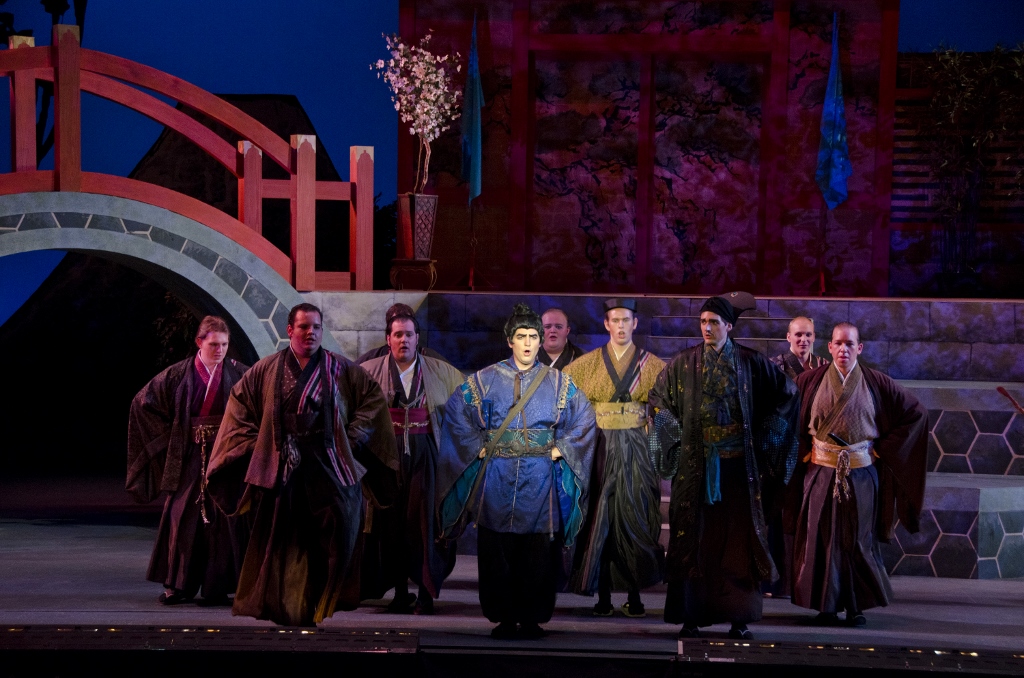
The Mikado, by Sir William Schwenk Gilbert and Sir Arthur Sullivan was produced in the Snow Drama Theatre at Brigham Young University-Idaho Spring Semester 2012.

Synopsis
Act I
The town of Titipu has not had an execution in a very long time.  The Mikado has decreed that unless there is an execution within a month the town will be demoted to the rank of village.  The Mikado has also decreed that flirting is a capital offense of which the tailor, Ko-Ko has been convicted.  The city fathers elevated Ko-Ko to the rank of Lord High Executioner thinking that since he is convicted of the capital crime, he would have to cut his own head off before he cut anyone else's head off.

Lord High Executioner was the highest rank in the town and all the other officials refused to work for the tailor except for Pooh-Bah, who then assumed all of their titles.

Ko-Ko is engaged to be married to Yum-Yum, who is in love with Nanki-Poo, a wandering minstrel who happens to be the son of the Mikado.  Nanki-Poo is in hiding in Titipu because his father has betrothed him to Katisha, an older woman who is not terribly attractive.  She has a very distinctive elbow, however.

Ko-Ko discovers that Nanki-Poo and Yum-Yum are in love and that Nanki-Poo will commit suicide if he can't be with her.  They hatch a plan whereby Yum-Yum and Nanki-Poo will be secretly wed and one month later Ko-Ko will cut off Nanki-Poo's head, and marry Yum-Yum thereby giving everyone what they want and saving the town from the rank of village.

Katisha enters and threatens to expose Nanki-Poo's secret, but the crowd shouts them down and she leaves, vowing to return.

Act II
As Yum-Yum is preparing for her wedding day, Ko-Ko and Pooh-Bah tell of a caveat in the law that says if a man is executed his wife must be buried alive with him.  Yum-Yum is unwilling to marry under this condition and Nanki-Pooh demands to be executed on the spot.  Ko-Ko can't perform the execution because he doesn't know how, and so he resigns himself to his fate and sends Nanki-Pooh and Yum-Yum off to be married by Pooh-Bah who is also the Archbishop of Titipu and who also forges a false report of execution.

Suddenly, Katisha and the Mikado arrive with an entourage and great fanfare.  Ko-Ko describes the execution in great detail to the delight of the Mikado and Katisha.  When they examine the death certificate they learn that the "victim" was the heir apparent to the throne of Japan.  The penalty for compassing the death of the heir apparent is death by lingering methods such as boiling oil.  When the conspirators, Ko-Ko, Pooh-Bah and Pitti-Sing say they didn't know he was the heir apparent, the Mikado is sympathetic to them but says there is no provision in the law for not knowing.  Their execution is scheduled for after lunch.

Ko-Ko finds Katisha, throws himself on her mercy, swears his undying love to her and asks that she intercede with the Mikado for him and his co-conspirators.  The Mikado grants them mercy, Ko-Ko and Katisha are to be wed which means that Nanki-Pooh and Yum-Yum can finally come out of hiding.  The Mikado is not pleased, nor is Katisha until Ko-Ko says that when the Mikado orders someone to be put to death they are as good as dead so you might as well just say they are dead, to which the Mikado says is satisfactory.

And they lived happily ever after.

Concept
The director and set designer, Richard Clifford gave the concept for our production of The Mikado of Ukiyo-e, or traditional Japanese woodblock prints.  We studied the medium and one of it's greatest artists, Utagawa Hiroshige.  Follow these links to see examples of Hiroshige's work:
Link     Link     Link     Link

Co-Designer
Kolby Clarke was a lighting student who was working on a portfolio to get ready for graduate school.  He had already assisted me and another designer on a couple of designs and had proven himself ready to take on more responsibility.  In fact after his work on The Mikado, we decided he was ready to solo, and assigned him to design the lights for Bielzy and Gottfried on our mainstage season.

I asked Kolby to be a co-designer on The Mikado.  The caveat being that I was still the designer of record and would have final say on anything we did.  We communicated well from the very beginning and were both striving to achieve the same goal from the same set of criterion so I didn't have to exercise my "veto" power a single time in this process.

Design and Execution
There were several conditions that I insisted on in the lighting design for The Mikado.  First, I wanted to use footlights because they would have been a primary light source for plays and operas written during the time of Gilbert and Sullivan and I wanted to express nostalgia in that way.  Second, I wished to use red, green, blue and amber downlights and mix to "white" in the air rather than in an instrument.  I had utilized this system of downlights on the lighting design of Phedre and had been very satisfied with the results.  I wished to use it again for The Mikado.  Third, I wanted to utilize strong sidelight. And fourth I wished to utilize the cyclorama in a meaningful way. 

Since this was a comic opera, there were several different types of songs.  There was recitative, which in an opera is like dialogue set to music.  In other words the recitative is the part where the story moves along.  Then there were the big production numbers.  Production numbers typically are a stoppage of time for an opportunity to explore one main idea with great music, fully orchestrated.  Typically these are the songs that everyone knows.  They sometimes are referred to as "show stoppers." 

The production numbers in The Mikado came in the form of solos, duets, trios, quartets, chorus numbers, and chorus numbers with solos, duets, trios, etc... fronting them.

As the lighting design evolved, we decided that we wished to light each type of musical number in a unique way.

Recitative
We decided to light recitative in normal theatrical light, mainly frontlight and downlight.  We also used some sidelight for these types of cues.  During the recitative we also decided to show the time of day and passage of time.  We did this with color and angle of lighting on the actors, and color shifts on the cyclorama.  We also lit the recitatives in full stage light.  Sometimes bright, sometimes dim depending on the scene.  As far as color in the lighting, we chose to blend the color in the lighting to "white" light.  While it wasn't truly white light, it was less colorful than the light we used in some of the show-stopping numbers.


Recitative--Pooh-Bah introducing himself to Nanki-Pooh

 
Recitative--Ko-Ko negotiating with Yum-Yum and Nanki-Pooh


Recitative--same scene, closer
 
 
Recitative--Pooh-Bah, Nanki-Pooh and Ko-Ko conspiring
 
 
Recitative--Yum-Yum, Nanki-Pooh and Ko-Ko.  The bad news
 
 
Recitative--The happy couple on the honeymoon


Recitative--Early evening


Recitative--Death for compassing the death of the heir apparent


Recitative--Ko-Ko and Katisha.  The solution

Production Numbers
Kolby and I decided the main numbers needed to be lit more theatrically.  We did this with almost no frontlight, instead relying on our footlights, downlights and sidelights.  We also used the cyclorama in a much less literal way, using colors that expressed the song rather than trying to replicate daylight.

A few of the production numbers were chorus only.  Some of them were solos, duets, trios or quartets with chorus backing, and some of the numbers were solos, duets, trios or quartets with no chorus on stage.  Each of these types of production numbers were lit in a slightly different way.

Chorus Numbers
The main chorus only numbers in The Mikado is "If You Want to Know Who We Are" by the men's chorus and "Comes a Train of Little Ladies" by the women's chorus.

Still utilizing primarily footlights, sidelights and downlights, we cheated just a little frontlight into the mix, just for blending for these two numbers.  Typically these songs were lit brighter than the other types of production numbers but not as brightly as some of the recitatives.  The lighting angles were more dramatic and the colors more saturated.  The cyclorama was also lit more for the song rather than for time of day.


Chorus Number--If You Want To Know Who We Are


Chorus Number--If You Want To Know Who We Are

Chorus Number--Comes a Train of Little Ladies

Chorus Numbers with Singers Fronting
The next major type of production number were the chorus numbers with a soloist, a duet, a trio or a quartet fronting.  These numbers were lit almost identically to the chorus only numbers with the exception that we lit the "frontman (or woman)" with followspots.

Primarily footlights, downlights and sidelights in more saturated colors, as well as the cyclorama in a color that seemed to fit the music.

We have four followspots in the Snow Drama Theatre and we utilized all of them for The Mikado.  When we had solos and duets, we hit each singer with two spots each.  One from house left and one from house right.


Solo with Chorus--A Wand'ring Minstrel I


Solo with Chorus--A Wand'ring Minstrel I


Solo with Chorus--I've Got a Little List


Solo with Chorus--I've Got a Little List


Trio with Chorus--Three Little Maids From School Are We


Solo with Chorus--A More Humane Mikado

Solos, Duets, Trios and Quartets
For the solos, duets, trios and quartets with no chorus onstage we lit the stage far less and allowed the spotlights to direct the audiences' eyes.  What little light we did utilize on stage was footlight, sidelight and downlight.    During these songs we really wished the focus to be on the singers rather than the whole of the environment. 

Once again, with the followspots, we chose to light the solos and duets with two lights on each actor, one light coming from house left and the other coming from house right.  That helps round the characters, I feel.  On the trios and quartets, though we lit each actor with only one light.


Duet--Were You Not To Ko-Ko Plighted


Trio--I Am So Proud


Solo--The Sun Whose Rays Are All Ablaze


Solo--The Sun Whose Rays Are All Ablaze


Quartet--Madrigal:  Brightly Dawns Our Wedding Day


Quartet--Madrigal:  Brightly Dawns Our Wedding Day


Duet--There is Beauty in the Bellow of the Blast

 Conclusion
This was a delightful production of The Mikado to work on.  From the great script and score and the execution of it by orchestra and singers, to the inspired casting and direction, the concept of Ukiyo-e and execution of that concept in a great set design to the beautiful and colorful costumes the landscape for a lighting designer was priceless. 

Working with a co-designer was very satisfying.  While it never seemed like there was less work for me to do in comparison with other shows I've designed on this scale, it was satisfying though to have another designer on the show giving ideas, giving input on ideas, and giving a different perspective on things.  I felt that we worked well together and that each of us made significant contributions to the final outcome.

Kolby was the right co-designer at the right time.  We had already worked together on several shows where he assisted me on the design and I felt he was ready to take a bigger role.  Because of his work on The Mikado I recommended him to the other faculty to take on a full lighting design of his own. 

Production Details
Directed by Richard Clifford
Musical Direction by David Olsen
Orchestral Direction by Robert Tueller
Scene Design by Richard Clifford
Lighting Design by Gary Benson
Co-Lighting Design by Kolby Clarke
Costume Design by Susan Whitfield
Sound Design by
Technical Director:  Ray Versluys
Costume Shop Director:  Patty Randall

Sunday, June 3, 2012

Amahl and the Night Visitors--Scene Design

The Star
The opera, Amahl and the Night Visitors by Gian Carlo Menotti was produced Fall Semester, 2003 in the Snow Drama Theatre at Brigham Young University-Idaho.

Synopsis
Amahl is a crippled boy with a very active imagination.  He has "cried wolf" too many times so his mother does not believe him when he says there is a wondrous star in the heavens.  She prays that her son will not have to become a beggar and goes to bed.  There is a knock on the door and Amahl answers it and finds the three wise men on their way to visit the Christ Child.

Amahl and his mother fetch the neighbors who dance for the kings and entertain them.  The kings show Amahl and his mother the things they are going to take as gifts for the Holy Child.  After the kings and Amahl have retired for the night, his mother attempts to steal some of the gold in an act of desperation.  She doesn't want Amahl to have to beg.  The page to the kings catches her in the act and is about to punish her when Amahl attacks him.  The kings are horrified that their gift of peace could lead to violence and they tell her to keep the gold.

They tell her who the gold is for and she is ashamed.  She tells the kings to take the gold to the Christ Child.  Amahl has nothing to give, so he offers his crutch to the kings to give to Him.  Amahl is miraculously healed and begs his mother to allow him to accompany the kings to Bethlehem to see the Holy Baby.  She does and he does.

Concept
Roger Merrill, the director told me he wanted to see the layers of the city and the surrounding hills in the set design for this piece.  He also suggested a cut away unit set.  Somewhere in the meeting he said he wanted a very big star.

Execution
I wanted to have a very biblical looking star.  Not a five point star or a star of David, but the iconic star with an elongated tail seen in many of the great masters' paintings of Bethlehem.  I knew I wanted it made of clear acrylic so it could be lit and glow.  I drew an image of what I wanted and took it to my friend, David Oliphant in the Physics department to help me get the math right.  David looked at what I had and broke it down into polygons, then he did the math.  The whole thing was based on a four inch cube with the head, tail and four arms projecting off the six planes of the cube.

David did the math and Ray Versluys did the cutting and the fabrication of the acrylic star.  It was a beautiful piece and really communicated to the audience exactly where and when the show was taking place.

The needs for this set were a door for the Wise Men to enter from, a window for Amahl to see who is at the door, two beds and some stools.  We added a second window piece that was a flown piece as Amahl is seated outside playing his flute at the top of the show and his mother has to call him in the house.

I asked Jessika Watson to assist me in this design.  She was a very bright student who has since gone on to get a degree in scenic design.  She did a great job on the show and did most of the model building.  Unfortunately, the model ceased to exist several years ago and I have no photographic evidence of it.  It was beautiful model, however.

I designed the house and the window unit to look like mud bricks and was intending to paint them and maybe have some foam pieces, but Ray Versluys, our technical director had been working in film construction for a very long time and suggested we use polyurethane spray foam insulation for a surface treatment.  He knew a local foam company and arranged for the pieces to be foamed.  It was relatively inexpensive and very effective.

The first piece we did was the flown windo piece.  There was enough of the wall to indicate a window and an exterior surface with the cutaway edge very similar to the cutaway edge of the rest of the set.  We carved the foam in places to indicate broken plaster and also the stones around the door and windows.  When it was painted we took raw umber paint and applied it heavily around stones and other parts of the set and then sprayed it with a spritzer bottle set on stream to create the aging and run marks.

The Wall

Another shot of The Wall

The Snow Drama Theatre has a proscenium arch that is 41'-4" wide by 20'-0" tall.  It is a very wide proscenium.  In designing this show, I had to balance several things.  The size of the proscenium, the idea that this was a poor person's home and the fact that a chorus of about fifty people were going to be on stage dancing.  We acheived that balance in a number of ways.  First we shrunk the proscenium by about 4 feet on each side, then we employed the cutaway aesthetic to the set which at the same time establishes boundaries and then allows you to break them.  Finally we showed the other buildings and homes around Amahl's home and we also showed the sand dunes in the back where the kings enter and exit from.

Set showing false proscenium, cutaway set, neighborhood buildings and dune field

Roger requested a ceiling piece at some point in the process and I designed a timber frame over Amahl's bed that we could hang things from.  The frame was built from blue styrofoam and painted to look like heavy timbers.  He also suggested we have a place in the room where Amahl's mother could prepare a meal so I designed a small stone oven in one of the walls.

Detail showing timbers and stone oven
I designed the floor to be a dirt floor and had intended it to be painted.  I didn't communicate that to the technical director very well and one day I came onstage and found the workers dumping topsoil everywhere and spreading it out.  It really did look good, but dust kicked up wherever anyone walked.  We were supposed to have the villagers dance, so that was going to be alot of dust every night.  It was especially bad because we had a full pit orchestra. 

We did a couple of things to keep the dust down which ultimately worked. First we placed straw all over the floor.  That helped.  I recommended that the scenic artists mix a clear acrylic sealer in water and spray it through a garden sprayer every day for a week or so.  Between the straw and the sealer, we were able to keep the dust down pretty well and still acheive the look of the real dirt floor.  By the time we introduced the orchestra to rehearsals, the dirt had been compressed to the point that it resembled hard pan.

Dirt floor, dancers, no dust

I made the curtains in the window out of monks cloth, which is one of the oldest weaves for textiles still in existence.  I cut holes in the fabric, cut the bottom irregularly and then snapped the fabric like a whip several times.  Monks cloth is such a loose weave that it will unravel rapidly when stressed in that way.  When I had acheived the look I wanted I immersed the monks cloth in a thin wash of raw umber paint and then air dried it, then I hung it in the window.

Curtains

Over the years the theatre department has done many biblical type shows, and we have accumulated quite a collection of biblical looking pieces for props and set dressing.  I used burlap bags, biblical looking pots and baskets, rags, three legged stools and an old style straw broom to dress this set.  We also built a rope bed for Amahl's mother and created some straw tick mattresses for Amahl and for his mother.

The set with dressing for Amahl and the Night Visitors
I enjoyed designing this opera.  I felt the set worked well, I also thought the performances were well done, dancing was well choreographed and overall a well directed piece.  It delighted the audiences and was quite successful.  It was well timed to correspond with the Christmas season.  I'm gratified to have had the opportunity to work on this production.

Production Details
Directed by Roger Merrill
Scene Design by Gary Benson
Costume Design by Susan Whitfield
Lighting Design by Ray Versluys
Technical Director:  Ray Versluys
Costume Shop Director:  Patty Randall