Showing posts with label proscenium. Show all posts

Tuesday, May 1, 2012

The Magic Flute--Costume Design

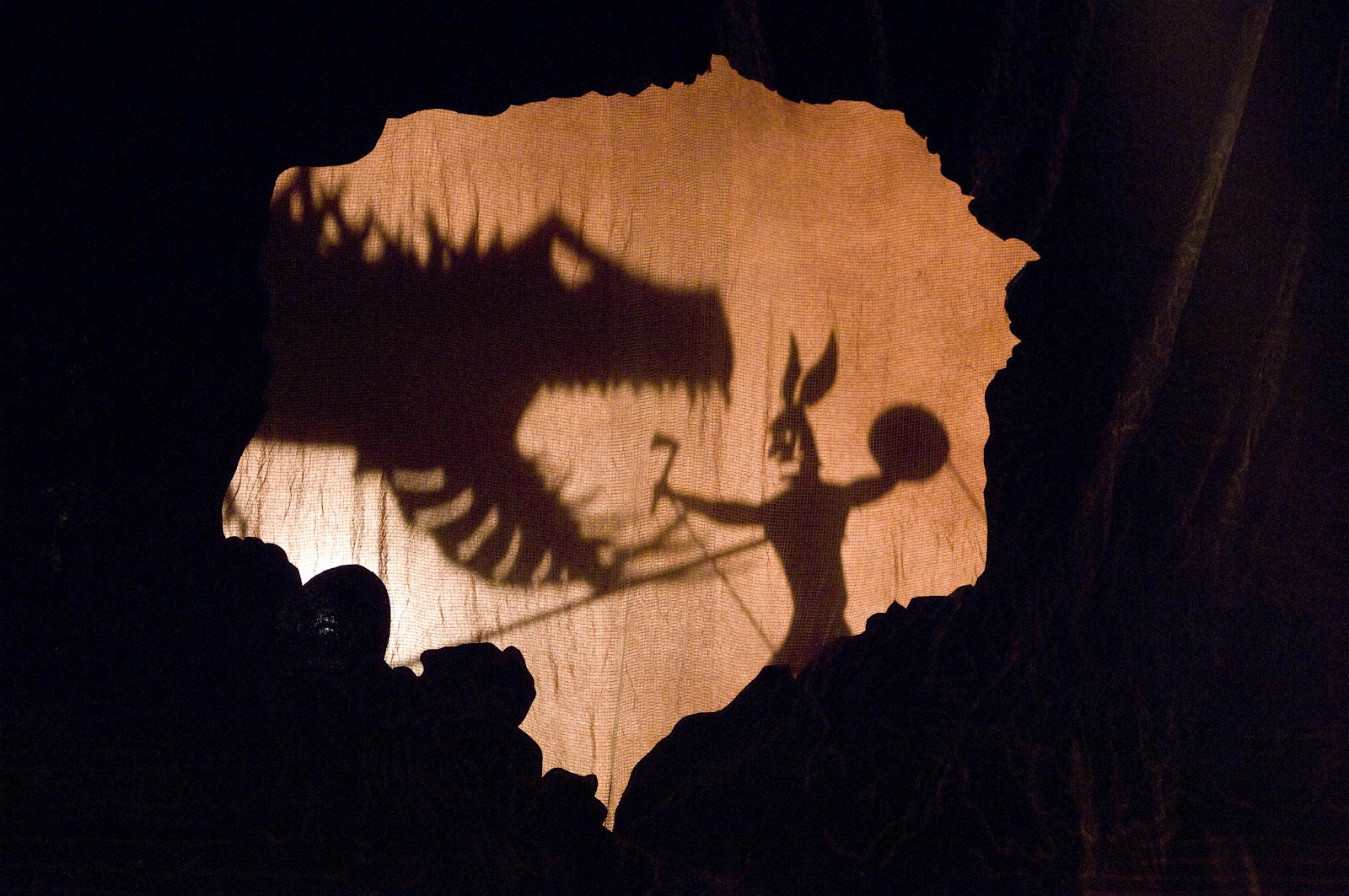
Shadow puppets designed by Carl Day
The Magic Flute, by Wolfgang Amadeus Mozart was produced at Brigham Young University-Idaho, Winter Semester, 2008 on the Snow Drama Theatre Stage.

Synopsis
Tamino, a prince from a distant land is battling a serpent.  Overcome with fatigue he faints and as he is about to be killed, the three ladies who are servants to the Queen of the Night slay the serpent and rescue him.  When he comes to, they show him a picture of Pamina with whom he falls madly in love.  The Queen of the Night appears and pleads with Tamino to rescue her daughter from the evil Sarastro.  He agrees, and with his new found trusty sidekick Papageno, the birdman, he sets out to find her and free her from bondage.

On his journey, however it is revealed that the Queen of the Night is the evil one and Sarastro is the benevolent one.  In order to become a modern man, and win the hand of Pamina, Tamino must pass through a number of trials.  Papageno also finds his soulmate, the beautiful birdgirl Papagena.  Finally, when Tamino and Pamina have passed through the trials of fire and water, the Queen of the Night and her evil henchman Monostatos are vanquished and the two are married.

Concept
This production was co-directed by Jon Linford of the BYU-Idaho Music Department and John Bidwell of the BYU-Idaho Theatre Department.  Jon suggested the concept that when European strength and vitality met Eastern sophistication and philosophy, the Renaissance was born.

We discussed what this meant at some length and determined that our hero, Tamino would be a northern barbarian who would slowly transform throughout the opera until he became a "modern" man.

Execution
We had a very talented young costume design student named Julie Brown that was trying to beef up a portfolio so she could apply to graduate school.  I agreed to take her on as an assistant designer for this show.  Julie was very good and so I decided she should be more of an associate designer and I gave her Pamina and the three spirits, as well as many of the chorus members to design.  She did a wonderful job on those costumes.  As part of the agreement, though since I was the designer of record, I retained right of approval on her costumes.  I do not feel that I abused that authority, however.

One challenge we had was the fact that many of the roles were double cast.  Tamino and Pamina, the Queen of the Night, and Papagena were all double cast.  Of all the characters, only the actresses who played Pamina were the same size.  For example, one of the queens of the night was at least six inches taller than the other.  So we had to build double costumes in some cases and find creative solutions in others.

As I was pondering the role of Tamino, I recalled an album cover of a 1970's southern rock band named Molly Hatchet.  It had a barbarian carrying a battleaxe and wearing a winged helm  This was my initial inspiration for his character.  I also really liked the fact that I could inject a little Rock and Roll into an opera.  Afterall, Mozart, in my opinion, was a rockstar in his day. 

I viewed Tamino as a Viking and dressed him in a blue tunic with an animal skin cape, breeches with cross gartered boots and the feathered helm.  I also had a student and good friend, Robert McKenzie build a Scottish targe for him.  In addition to that I bought him a bearded axe.

Tamino in battle dress with axe and targe
Tamino vanquished, with helm and targe
The transformation of Tamino began in the first scene when the three ladies remove his helm, take his axe and targe. 

The transformation begins
As Tamino grew more and more civilized, he lost more and more of the northern barbarian look and became more refined.  After the weapons and armor were taken, the next step of the transformation was the animal skin cloak.

Tamino continued to change, sporting neatly coifed, dark hair in an 18th century style, no mustache, and wearing penitent's robes

Tamino in penitent's robes
Finally, when he has passed all Sorastro's tests, Tamino is transformed into a modern Renaissance man in full 18th century regalia.  I found a piece of upholstery fabric at Home Fabrics in Idaho Falls, Idaho that was a blue chenille with a great gold thread design.  I knew it had to be Tamino's suit.  We also covered his tri-corn hat with it.

Tamino's suit
(promo shot)

Pamina, Sarastro and Tamino as the newly enlightened
Sarastro was played by the great Norman Bailey, who celebrated his 75th birthday by coming out of retirement to play the role.  Sarastro's tunic and robes were also made of upholstery fabric and his hat was actually a fur covered band hat that we refurbished and wrapped with linen.

The Queen of the Night was an interesting challenge to design.  The first time we see her we need to identify with her because we believe she is an injured mother who only wants the return of her daughter.  The second time we meet her we realize that she is the embodiment of pure evil.  In addition to this she must be at all times spectacular.

I decided she should be in full 18th century costume with the underdress, paniers and an overdress.  I also cheated just a little and gave her an Elizabethan standing collar in black boned lace.  I designed an enormous hooded cape for her out of sheer purple and blue organza which she kept on for the entirety of her first entrance.  The cape hid the sinister, 18th century horned goddes wig that we styled. 

I found a dark purple tafetta with a swag design which we turned upside down and cut out the bottom row of swags which gave it a batwing design.  This I backed with a pleated black satin ruffle about nine inches long.  The overdress was constructed out of a black chenille with gold thread and trimmed in purple.  Finally, the hood was large and the cape was 20 feet long by 15 feet wide.  The edges were cut with a batwing profile and made sturdy by sewing tie-line in the hem.  We also had wooden rods for her hands to hold the cape out at different moments of the aria.

I found some pointy witch shoes online and finished the costume by adding about a hundred dollars of colorless acrylic gems to all parts of the costume, including her earrings, shoes and wig. 

Her first entrance was stunning.  She had her back to the audience and was in total darkness.  The front of the stage was lit so we barely saw her silhouette against the black star drop.  The cape was spread out over the stairs and when the lights bled up over the stage it was breathtaking.  She turned and delivered her first aria without removing the hood or the cape.  On her second aria she was without the hood and we saw the horned wig for the first time and through costume realized she was evil

Unfortunately, someone released the spotlight crew on picture call night so we don't have images with the correct lighting in many cases.  That's a shame as it was a beautiful lighting design.

The Queen of the Night
More the Queen of the Night
Can't get enought of the Queen of the Night
The horned goddess wig
(promo shot)
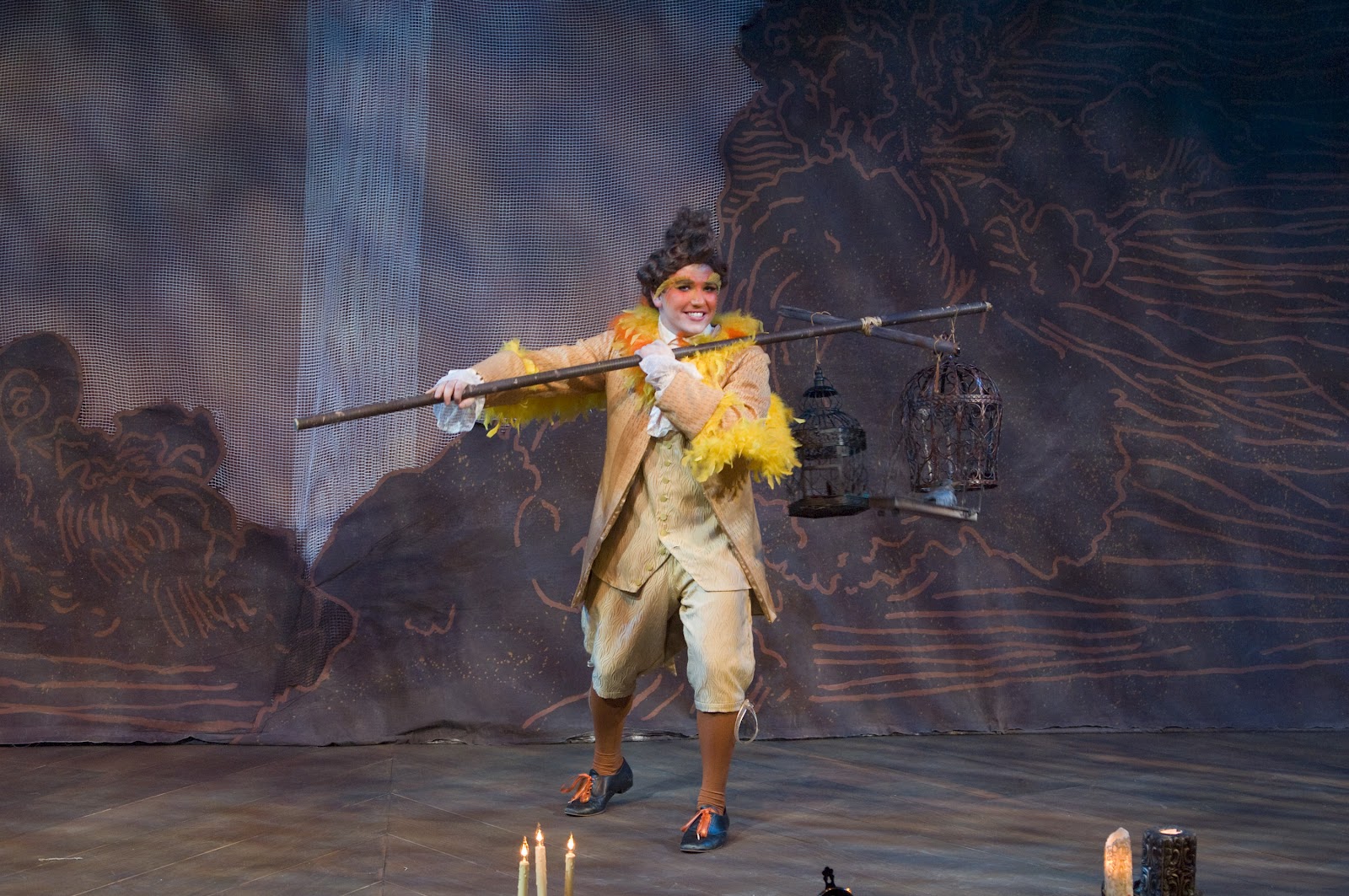
I decided to use alot of feathers for the bird people, Papageno and Papagena.  I also decided to color coordinate them as they would be in nature.  Yellow and orange seemed appropriate to me, possibly because canaries are harmless and their only purpose in life is to sing and be delightful.  I viewed Papageno and Papagena in that way.

I asked Lindsay Lopez to design their makeup and requested that she incorporate ostrich plumes into their eyebrows.  I also asked Celeste Harper to style the wigs.  She styled an 18th century wig for Papageno which abracted a coxcomb on top and an 18th century ladies wig for Papagena with ostrich plumes woven throughout.

Papageno was dressed in traditional 18th century garb except that he tended to sprout yellow and orange feathers from the seams in his jacket.  He also had a yellow and orange collar made of a feather boa.  Papageno also sported a shaved ostrich plume tail.
Papageno
Papagena comes to Papageno disguised as an old hag.  He has to prove himself to her before she is revealed as the beautiful bird girl.  I told Patty Randall, the costume shop director that I wanted Papagena to be able to begin as the old hag, turn around one time and be revealed as the beautiful bird girl, complete with an ostrich plume tail.  But I didn't want anyone to assist her and I didn't want any fabric from the old hag left on stage.  In other words I wanted magic.

If we had allowed an assitant or allowed fabric to be left on stage it would have been easy.  All we would have had to do is remove a cloak and voila she would be revealed.  I didn't want anything that easy.  I wanted the hag costume to melt away and the bird girl to appear.  I wanted jaws to drop.

Patty is a very gifted pattern maker and came up with a solution to this impossible problem almost without any hesitation.  It involved Papagena getting dressed in her bird girl costume, then lifting everything up and stepping into the hag costume but tied at the waist and pulled up to conceal the pretty costume.  Then we added witch gloves which were long opera gloves dyed grey with witch fingertips glued to the fingers.

Papagena would say her last lines as the hag while carefully pulling her fingers out of the gloves, then she would turn around and part the hag robe with her hands and gravity did the rest.  The transformation was spectacular.  The old crone literally melted away and Papagena appeared and the audience had a collective jaw drop every night.  And there was no fabric left behind.  Magic.

Papageno and the Hag
Papageno and Papagena
For Monostatos, I pulled his costume primarily from stock.  A piece from one show, another piece from a different one and so on.  Where I really had fun with his costume, though was in the accessories.  I made him a heavy beaded necklace with imitation human vertabrae and finger bones tied into it.  I braided bones into his hair and bought a massive shamshir (curved sword).  I also gave him a "ZZ Top" style beard as another homage to Rock and Roll.

Monostatos
The Two Armed Men were fun costumes to create.  I went back to my high school days and the first costume I ever designed to create them.  I was cast as the 4th Knight in Once Upon a Mattress and complained to my teacher that I needed armor if I was going to be a knight.  He said I'd have to build it myself and suggesed I make it out of milk jugs.  Long story short, I did and it turned out great, both in high school and in The Magic Flute.  I credit that high school experience as the one that really got me on the path to being a designer

I rented helmets for the two armed men and decorated them with coque feathers.  We had some old vacuum formed scale armor breastplates that I used, and then I outfitted them with heavy knit thermal underwear that was dyed grey, then I cut out armor pieces out of milk jugs and plastic soda bottles.  We painted them and stitched them to the thermal underwear.

The gauntlets, though were the best part.  I bought grey cotton knit gloves and cut out finger armor from the handles on the milk jugs and then stitched the handles to the fingers on the gloves.  I've used that on Halloween costumes for my boys as well.  It's a really great way to get cool armor cheap.

I finished the costumes off with high boots and breeches from costume stock.  The final touch and my last homage to Rock Music were the rockstar wigs I put on these two men.

Two armed men in "milk jug armor"
Julie's designs for this show were very good.  She clothed Pamina in a blue-green tafetta gown with a sheer organza veil.  Both the gown and the veil were embroidered.  She looked stunning.

Pamina's gown
Jon Linford, the co-director said he wanted the Three Spirits to look like Mozart as a child.  The Three Spirits are pants roles for women, by the way.  Julie designed these wonderful skirted vests and frocks for them, each in a different color.  I felt they were missing something because they were supposed to be spirits and yet they were really grounded in reality.  I happened upon a 1908 lithograph for the original Le Chevalier D'Eon which showed in the bottom left corner, a child wearing 18th century garb but with insect wings.  I knew we had several sets of Victoria's Secret style angel wings and knew it was the right thing to add.  I had to convince Julie of this but I think she was okay with it by the end.  The wings didn't obscure any of the costumes she had designed, they just gave the Three Spirits just enough whimsy to suggest they were from a different world.

To my knowledge that is the only alteration I made to any of Julie's designs.

The Three Spirits
We have done several biblical shows over the years and we have a great deal of biblical costumes in stock.  We used these to outfit the priestly chorus.

The Priestly Chorus
I had never been a fan of opera before this one.  Jon Linford has an enthusiasm for the medium that is infectious, though.  This opera was a true joy to work on.  Satisfying in every way.  The collaboration of the whole design team worked very well.  Since this experience, I've given opera another chance and have enjoyed the other three I've worked on since. 

Production Details
  • Directed by Jon Linford and John Bidwell
  • Costume Design by Gary Benson
  • Associate Costume Designer:  Julie Brown Hogge
  • Scene Design by Richard Clifford
  • Lighting Design by Brent Prichett
  • Costume Shop Director:  Patty Randall
  • Technical Director:  Ray Versluys

Saturday, April 28, 2012

The Taming of the Shrew--Scene Design

All is well
The Taming of the Shrew, by William Shakespeare was produced at Brigham Young University-Idaho on the Snow Drama Theatre stage, Fall Semester, 2007

Synopsis
Signor Baptista has a problem.  He has two daughters of marriageable age, the young desirable Bianca and the older, shrewish Katherina.  Baptista has sworn not to allow Bianca to marry until a husband is found for Kate.  No one in Padua wishes to be married to Kate because her temper is notorious.  Bianca has no lack of suitors, including Hortensio, Gremio and Lucentio.  Hortensio and Lucentio pose as tutors in disguise, unbeknownst to Baptista and each other so they may secretly woo Bianca. 

Meanwhile, Petruchio has arrived in Padua from the country with the purpose of finding a rich wife.  His old friend, Hortensio hears of this and recruits him to court Katherina.  Petruchio agrees and the courtship begins.  Petruchio uses reverse psychology on Kate calling good bad and bad good.  She agrees to marry him and at the wedding, he shows up in a strange outfit where nothing matches, acts drunk, threatens the crowd, punches the parson and takes Kate back to his home.

When they arrive, he won't allow her to eat because the meat has been burned and isn't fit for a woman as beautiful as she.  He won't let her sleep because the bed is not worthy of her.  He has a dressmaker bring a beautiful gown for her which she loves but he shreds it in front of her because it was too plain for someone as beautiful as she.  This is his process for "taming" her. 

Back in Padua, Lucentio and Bianca have secretly eloped and there are some delightful scenes involving disguise and discovery.  Petruchio and Kate come back to Padua for a visit and meet Lucentio's father on the road.  Petruchio refers to him as a woman and Kate agrees.  He says the sun is the moon to which she also agrees.  This is evidence to him that she is truly tamed. 

At Baptista's house, Hortensio has married a rich widow, and Lucentio has married Bianca.  Petruchio, Lucentio and Hortensio make a wager as to who has the better wife.  The test is for the wife to get the husband a drink.  Bianca and the rich widow both refuse but Katherine obeys.  Then she scolds the other two women and condemns them for not serving their husbands.  That provokes Petruchio to utter the famous line, "Why, there's a wench, come on, and kiss me Kate".

This play is still controversial after more than 400 years.

Concept
Because this is a small cast show, Hyrum Conrad, the director wanted me to shrink the playing area of the stage.  At the same time, he wanted me to show the wide open vistas of the Itallian countryside.  He also wished to use the turntable with multiple levels to show the different locations.

The play has multiple locations, both interior and exterior and we wanted the scene changes to be quick so as not to interrupt the flow of the play.

Execution
I decided to use portals of descending size to shrink the stage around the turntable.  The effect was similar to the acoustical shell at The Hollywood Bowl.  I didn't want that to get claustrophobic for the audience, though so I found a photograph of the Itallian countryside and we painted a drop at the rear of the stage, then projected the image forward on each of the portals in kind of an exploded view.  This allowed me to shrink and expand the stage at the same time.


Portals.  Scene:  Meeting Lucentio's father on the road to Padua
Hollywood Bowl Image  Link
We decided very early in the process to use the turntable primarily for interior scenes and to use the space in front of the turntable for the exterior scenes.  The portals would also be lit for the exterior scenes and not for the interiors.  We held to this convention with few exceptions. 


Inside Baptista's home
Lucentio and Hortensio wooing Bianca in her budoir
Interior of Petruchio's house. 
Trees and windows flown.
For the exterior scenes in Padua, I designed tracked wagons with the leading edge curved to fit the turntable.  These wagons were situated in between the portals.  The wagons had inline, fixed casters to facilitate them moving in and out without deviation from their course.  The stage crew dressed the wagons with doors and other objects while backstage.  In addition to the doors, we also flew windows in.

We had three different looks.  We had marble painted doors and windows for the scenes in front of Baptista's house, a different set for Hortensio's house and a third for Lucentio's house.  We also had a rooftop piece that flew in during several scenes.


Street in front of Baptista's house
Street in front of Hortensio's house
Street in front of Lucentio's house, Pedant in the window
The convention worked very well and we were able to conduct our scene changes very efficiently.  This was a delightful show.  I am gratified to have had the opportunity to work on it.

Production Details
  • Directed by Hyrum Conrad
  • Scene Design by Gary Benson
  • Costume Design by Susan Whitfield
  • Lighting Design by Richard Clifford
  • Technical Director:  Ray Versluys
  • Costume Shop Director:  Patty Randall

Thursday, April 26, 2012

Into the Woods--Scene Design


Preshow
Into The Woods, with music and lyrics by Stephen Sondheim and book by James Lapine was produced at Brigham Young University-Idaho on the Snow Drama Theatre stage, winter semester, 2004.

Synopsis
Act I interweaves the tales of Cinderella, Jack and the Beanstock and The Baker's Wife.  Little Red Riding Hood and Rapunzel are thrown in for good measure.  The play begins with the characters from the three main storylines singing about their problems and each decides the answer lies "Into the Woods".  At the end of the act, Cinderella has her prince, Jack has his fortune, the Baker and his wife have a child, Red Riding Hood has her grandmother back and Rapunzel has escaped with her prince.

Act II is what happens after they have "lived happily ever after".  Cinderella, Jack and the Baker and his wife once again decide the answer to their problems lies "Into the Woods".  Rapunzel loses her mind, her prince and Cinderella's prince run off with Sleeping Beauty and Snow White, the Baker's wife and many others are killed when the wife of the giant Jack killed comes down a second beanstalk and terrorizes the countryside.  By the end of the play, the few characters left are refugees trying to survive.

Act I is delightful and Act II is dark. 

Concept
Originally, the director, John Bidwell wanted to see the woods in the background and three flown rooflines of the three main storys.  When the characters went "Into the Woods" the rooflines would fly out and they'd be in the forest.  I thought we should have a bigger contrast between the characters in their homes and when they went "Into the Woods" during the song.  I suggested we start the show with three large storybooks onstage in front of the main rag.  I drew some sketches and convinced John to let me try.  I think the outcome was definitely worth it.

Execution
We already had a false proscenium in place from the previous show and I decided to utilize it and we repainted it with fairly cartoony, castle stone and cut three windows in it that we then covered with muslin and painted in a transluscent, stained glass style.  One of the windows had a hinge on it and would become Rapunzel's tower. 


Rapunzel's tower in false proscenium

I designed three storybooks, all between 6'-6" and 7'-6" tall.  The front covers were designed to open and reveal scenes on the inside for each of the main storys.  Since the Rapunzel and Red Riding Hood stories were more sub-plots than main storylines, they did not get their own books.

The storybooks all had gold "embossed" designs on the front covers and the title imprinted in gold on the spine.  This was done with gold paint pens.


Gold "embossing"

The pre-show look had the three books in front of the red curtain and we also built a couple of trees downstage of the proscenium.  The lighting designer requested a haze fog to be in place so there would be alot of ambience in the auditorium.

When the books opened the narrator's lines of introduction for that scene were lettered on the inside of the front covers.  I like illustrated stories, so I painted a few illuminations in the text of each of the books.  I thought they fit pretty well.


Cinderella's book--Act I
 Illumination

Jack's book--Act I
The Baker's book--Act I
When the characters sang the song, "Into the Woods", the red rag flew out and the books were wheeled out by hidden stagehands and the woods were revealed. When the books were offstage, they were re-dressed with an interior scene for Act II. 

Cinderella's book, Act II
Jack's book, Act II
The Baker's Wife book, Act II

As a designer, especially in a show like this I like to have a big reveal moment.  When the main rag flew out, the audience saw a large rock in the middle of the stage and fourteen large, shop built trees.  The teasers curtains had all been replaced with cut drops that had a foliage profile cut on the lower edge.  The effect was that we had entered a different world.


Shop built trees
I had camped near a glacial boulder field in Allegheny State Park back in the early nineties and had been intrigued by the trees that had beaten the odds and had grown anyway.  They had sent out roots over boulders to find any soil at all to grow in.  It was as if they were giant hands grasping the rock.  I remember thinking, "One day I'll use this".  That was the basis for the woods part of this design.

Ray Versluys, our technical director built a superstructure for the trees out of scrap lumber and sono tube.  He then covered the structure with chicken wire, shaped it and draped cheesecloth over that.  He arranged for a guy to come in and spray urethane foam on the trees to give them their final form.  It was really neat to see that in process.  It gave a great texture and really looked legitimate.


Rear view of shop built trees showing frame, chicken wire and urethane foam
Showing foliage cut teaser drops providing forest canopy.  Rock turntable with outriggers
The rock in the center of the stage was built very much like the trees, with a superstructure and then urethane foam.  It was built on an existing turntable, but I wanted it to be larger than the turntable and I wanted it to turn avista so Red could skip through the forest before she met the wolf.

We did this by building strange shaped outriggers with fixed casters underneath them that attached to the bigger rock.  The reality of the turntable was that it moved quite slowly so we really were only able to change the look of the stage during scene shifts rather than it being the dynamic moment I had wished for.  In addition to the turntable, I also designed the trees to be on wagons so stagehands could change the look of the space with new tree placements.


Jack and the Baker waiting to kill the giantess
This was a fun show to work on.  I'm glad I had the opportunity to do so.

More images Here

Production Details
Directed by John Bidwell
Scene Design by Gary Benson
Costume Design by Susan Whitfield
Lighting Design by John Moran
Technical Director:  Ray Versluys
Costume Shop Director:  Patty Randall