Showing posts with label drama. Show all posts

Sunday, April 26, 2015

Burdens of Earth--Lighting Design

Carl Day as Joseph Smith Jr.

Burdens of Earth by Susan Howe was produced winter semester, 2009 in the Snow Black Box Theatre at Brigham Young University-Idaho

About This Play
This play is a dramatization of events in the five month incarceration of Joseph Smith, Hyrum Smith, Lyman Wight, Caleb Baldwin and Alexander McCrae in the Liberty Jail in Liberty, Missouri.  Smith and his companions were arrested and held in the Liberty Jail from December 1st, 1838 to April 6th, 1839.

Mormons revere this time as a defining moment in the life of founder, Joseph Smith.  At his lowest point he wrote sections 121, 122, and 123 of the Doctrine and Covenants, a volume of revelation and scripture in the Mormon faith.

About The Jail
The Liberty Jail was a double wall masonry building with a two foot thick limestone exterior and a one foot square timber interior wall.  Between the masonry wall and the timber wall there was a foot of space filled with loose rubble to discourage prisoners from tunneling out.

There was a room above for the guards during the day and a dungeon below.  At night, when the guards were not present, the door of the prison was barred and the prisoners had access to that room as well.  The inside dimensions of the jail were fourteen and a half feet by fourteen feet.  The room below had a six foot ceiling and the room above had a seven foot ceiling.

In the lower level, the only openings were two small iron bar covered windows six inches tall by two feet long.  I am unsure if there was glass in those windows.  Upstairs there were two larger, iron bar covered windows.  Between the upper level and the lower level was a heavy trap door.

The prisoners were held here during the coldest part of the winter of 1839 without blankets or bedding, only straw on the stone floor for comfort.  Food was scant and not very good.  Accounts at the time suggested it was sometimes poisoned or worse.

Because the charges they were being held on were thin at best, on April 6th during a prison transfer, the sheriff and the guards got drunk on whiskey and the one sober guard helped the prisoners saddle up and escape.

The jail was later used as an icehouse and later torn down.  The floor of the dungeon and part of the foundation remained and in 1963 it was purchased by the Church of Jesus Christ of Latter-day Saints, or the Mormons.  The jail was partially rebuilt inside a visitors center.  An image of the reconstruction can be seen here.

Because of the revelations received there and how defining it was for Joseph Smith, the Liberty Jail is considered a sacred site for Mormons.  Susan Howe's play, Burdens of Earth explores the time just before their escape, at the lowest point for Joseph Smith when he is questioning himself.

Synopsis
There are three different kinds of scenes within this play.  The first type of scene takes place in Joseph Smith's present, in the jail.  The second type of scene takes place in his memory or in the memories of others.  The third type of scene takes place in his imagination, thinking what if I had done "this" differently.  For much of the play, Joseph is upstairs writing at the jailer's desk while his companions are huddled for warmth down below.  There is a single candle upstairs for light and a small lantern in the dungeon below.

During the play, the four companions of Joseph Smith portray themselves in the present and other people in the flashbacks or imaginary scenes.  Sometimes they portray sympathetic characters and sometimes they portray belligerent characters.

The climax of the play is when Joseph Smith receives the revelation that becomes the 121st, 122nd and 123rd sections of the Doctrine and Covenants.  The incarceration of Joseph Smith changed him and he became even more committed to the safety and security of the Saints than he had been previously.  He also became more serious and driven as a leader.

About the Set
Richard Clifford, the scene designer and Roger Merrill, the director took a research trip to Liberty, Missouri to see the jail and to take measurements and learn as much as they could about it.  They decided to create a full sized replica of the actual reconstruction of the jail in the Snow Black Box Theatre.  It was an impressive set.  The Snow Black Box Theatre is large enough that the full sized replica could fit inside.

There was a rampart down below that showed the foundation of the jail and it was used during the flashback scenes as a path or a work space.

The set for Burdens of Earth

The Lighting Design
For the scenes set in the jail in the present, the lighting was pretty straightforward.  The scene designer had a single candle in the room upstairs for a light source and a small lantern downstairs.  In addition, there were the four windows in which moonlight could stream for motivational light sources.

Since the play took place at night, I was able to use minimal directional lighting for these scenes and fill them with blue light.

Motivational lighting on Joseph and Hyrum Smith

Candlelight coming from the left, moonlight coming from the right

Motivational light in the dungeon, 

Lighting the upper and lower levels

Pink light on floor is a window gobo just before dawn

Moonlight from the window

I lit the memory scenes and the "what if" scenes in much the same way.  Some of those scenes were happy memories and some of them were not so happy.  This play takes place during the "1838 Mormon War" in Missouri.  Some of the depredations of that war are dramatized.

I chose soft, warm light to dramatize the happier memories, sometimes with leafy breakup to show an exterior scene.  Because of the cantilever of the upper floor over the lower room and because there were walls covering the sides of the jail, I had to install some low profile small fixtures into the beams of the floor to get light inside.

During many of the scenes inside Joseph's head, he was an observer.  It may have been something he witnessed, or it may have been something he heard about later.  Most of those scenes played out on the lower level with Joseph standing or sitting on the upper level.  I lit Joseph in the present and the other actors in the memory for those scenes.

Oliver Cowdrey comes to the Smith home

Joseph and Hyrum in the present, Oliver in the memory

Joseph lamenting the alienation of Oliver Cowdrey

Foliage breakup on memory scene on rampart

Dark memory scene on rampart

Memory scene played on dungeon floor

Violent memory, blood red light with leafy breakup

Remembering a member who left

Coming into the light

Interior scene in memory

Remembering a happier day

I enjoyed working on this show.  It had been an original script first played at BYU in Provo, Utah in 2001.  It seemed to be an honest exploration of Joseph Smith and his companions rather than being sentimental, which so many scripts like this tend to be.  We had a solid cast, great designs and a very good production.  It was a pleasure to work on.


At the climax of the play.  Always darkest before the dawn

Production Details
Directed by Roger Merrill
Scene Design by Richard Clifford
Lighting Design by Gary Benson
Costume Design by Susan Whitfield
Sound Design by Antonia Clifford
Technical Director:  Ray Versluys
Costume Shop Director:  Patty Randall

Monday, May 13, 2013

The Spitfire Grill--Scene Design

The Spitfire Grill

The Spitfire Grill, the musical by James Valcq and Fred Alley, was produced in the Kirkham Arena Theatre at Brigham Young University-Idaho, Fall Semester, 2006.

Synopsis
Percy Talbott is a young woman, just released from prison looking for a fresh start.  During her incarceration she clipped a picture of Gilead, Wisconsin from a travel magazine and has determined she will move there.  When she arrives, she is met with suspicion from all she meets.  The sheriff, Joe Sutter, convinces the owner of The Spitfire Grill, Hannah Ferguson to give her a job.

Things don't go so well at first but finally the women settle into a tenuous truce.  Hannah has a bad fall in which she breaks her leg and Percy is left to take care of the grill and it's patrons by herself.  Hannah asks Percy to leave a wrapped loaf of bread by an old stump behind the diner.

Percy is useless in the kitchen and is joined by Shelby, the wife of Caleb, Hannah's nephew.  Together they make sense of the business and in the process become close friends.  Caleb is unhappy with this situation.

The three women, Hannah, Percy and Shelby become very close and Hannah tells them she has been trying unsuccessfully to sell the grill.  Percy comes up with an idea to raffle off the grill with an essay contest.  One hundred dollars to enter, best essay wins the grill.  Caleb, a real estate agent who has had the grill listed for ten years is upset by this plan and feels he is losing control of everything around him.  He decides to investigate Percy.

Percy confides in Shelby why she was in prison.  Her stepfather raped her and when she became pregnant, he beat her repeatedly until she miscarried the baby.  Then he raped her again and when he fell asleep she slit his throat with a straight razor.  It seems that almost everyone has forgiven Percy but she cannot forgive herself.

The advertisement for the raffle is a huge success and letters from all over the country come pouring in.  Everyone in town gets caught up in the excitement.  Everyone except Caleb.  New life comes to Gilead.

All through this, Percy keeps leaving the loaf of bread at the stump and we meet Eli, Hannah's son who deserted from the army during the Viet Nam War.  He is homeless and a vagrant.  Living on the bread left by his mother.  He leads Percy to the mountain top where she finally learns to forgive herself. 

Percy helps to reunite Hannah and Eli and everyone is reconciled.  Hannah gives the grill to Percy and Shelby as there advertisement was the best essay about the place.

Great script, wonderful production. 

Concept
The director, Roger Merrill wanted us as a design team to explore the idea that this was a town in limbo, a stagnant, static place.  He also wanted a unit set without scene changes.  The challenge for this was the fact that the play begins in prison, goes to the exterior of Gilead to the interior of the grill, then behind the grill to the woodpile.  There's a scene in several locations in the town and finally to the mountaintop.

As Roger was talking about what he wanted to say with the show, I kept having images of octagons moving through my mind.  I didn't understand at first why octagons, but I went with them.  I sketched up several thumbnail groundplans that involved octagonal decks and showed them to Roger.  I was unsatisfied with not knowing why octagons and began to intellectualize my choice.  I determined that this was a play about halted progression, and that octagons were the international shape of the stop sign.  The important thing about stop signs is that they are only temporary and progression can begin again, which is also a theme in this play.

Thumbnail groundplans

Thumbnail groundplan

Execution
Since this was a unit set, we knew we were going to change locations with lighting for many of the scenes.  The Kirkham Arena Theatre was a found space theatre without a fly loft.  I decided to add a cyclorama to the back of the set to facilitate lighting shifts.  It also helped to create a kind of limbo in which to tell the story of the play.  We didn't want the cyc to be lit all of the time, so I placed a poorman's scrim three feet in front of it.  The poorman's scrim was created with brown tricot stretched tightly on a frame.  I had already used tricot in this fashion before in my career and knew it would work.

There was a serendipitous effect when Richard Clifford, the lighting designer focused a source four with a cloud gobo on the scrim and it ghosted through to the cyc which gave us a double image of the clouds.  I used that effect a few years later on my lighting design of Oedipus.  It was stunning.

Percy and Shelby in front of the dark scrim

Clouds ghosting on the scrim and cyc. Effy, Shelby, Joe and Caleb

Nighttime on the cyc, Percy and Eli

As I designed the set, I chose to use two octagons to symbolize the interior of the grill.  Since the majority of the play took place in the two rooms of the diner, I added much more detail on those two platforms.  The upper platform was the kitchen and had a refrigerator, a counter, a stove and a backsplash.  The lower platform was the dining area and had a wainscot and a couple of tables and some chairs.

Downstage left I designed a lower, smaller octagonal platform to be the entrance to the grill and downstage right I designed another octagonal platform that functioned as the back porch.  Outside of the porch I dressed the set with a stump and an axe and a pile of wood.

Upstage right I designed a half octagon platform that was much higher and was at the level of the top of the backsplash.  This platform functioned as both the prison and the mountaintop.  It gave the sense of coming full circle.

Hannah on the upper octagonal platform, the kitchen

Caleb on the lower octagonal platform, the dining room

Percy, Joe, Shelby and Hannah on the dining room deck reading the raffle entries

Percy and Joe on the small exterior platform DSL

Shelby and Percy on the back porch

Percy and Hannah with the loaf of bread on the stump behind the grill

Three non-descript locations somewhere in Gilead

The half octagon as the prison, with Percy

The half octagon as the mountaintop, with Eli and Percy

Octagons, with Percy and Joe

I enjoyed working on this show very much.  I felt that the scene, lighting and costume designs all came together to fulfill the director's vision of The Spitfire Grill.  This is a great script and it is almost impossible to exit the theatre without having an emotional experience with the material.  I'm glad I had the opportunity to work on it.

Production Details
Directed by Roger Merrill
Scene Design by Gary Benson
Lighting Design by Richard Clifford
Costume Design by Susan Whitfield
Technical Director:  Ray Versluys
Costume Shop Director:  Patty Randall

Saturday, June 30, 2012

Macbeth--Scene Design

Lady Macbeth, hands dripping with Duncan's blood

Macbeth, by William Shakespeare was produced Winter Semester, 2010 in the Snow Black Box Theatre at Brigham Young University-Idaho.

Synopsis
The story of Macbeth is well known.  Macbeth and Banquo, heroes of the Scottish king Duncan happen upon the three weird sisters, witches who tell them that he, Macbeth will become Thane of Cawdor and thereafter king of Scotland.  They tell Banquo he will sire a line of kings but will not attain kingship himself.

Shortly after, a messenger arrives and hails Macbeth as Thane of Cawdor because the previous thane had taken up arms against the king and was sentenced to death.  Macbeth instantly begins to believe the witches and tells his wife about their prophecies.  Lady Macbeth has no reservations about her own ambitions and commands Macbeth to slay Duncan while he is a guest in their castle.

Thus begins Macbeth's descent into murder and madness.  He finds he has to commit many murders to cover up the first.  He is haunted by the ghost of his friend, Banquo whom he also had put to death.  Lady Macbeth does not escape the fate of madness either as she sleepwalks and attempts to rid herself of the blood on her hands.  Lady Macbeth committs suicide rather than live with the guilt.

Macbeth lives with the confidence of the witches prophecy that he will rule until Birnam Wood comes to Dunsinane and that no man born of woman can slay him.  When he realizes that the English army, led by Macduff is advancing on Dunsinane, concealing themselves with hewn boughs from the trees of Birnam Wood he panics.  He still does not believe he can be killed until his final battle with Macduff where it is revealed that Macduff was from his "mother's womb untimely ripped."

Macbeth is beheaded and Malcolm, Duncan's son is placed upon the throne.

Concept
Roger Merrill, the director wanted our production of Macbeth to be both simple and complex.  He wanted the overall design to be austere with little scenery and just a few furniture pieces and changes in light to indicate change of scene.  He also wanted to have trap doors and elevators concealed within the stage to provide entrances and exits for the witches.  He had an idea that the witches would come up on the battlefield through the stage and drag the fallen soldiers through the trapdoors to hell.

We also decided we could tell the story better with a thrust stage.

I suggested that we paint a map of Scotland, on parchment, on the floor with the important placenames indicated.  That way the stage could be wherever we wished it to be.  Somewhere in the discussion the idea of having strips of fabric hanging at the back of the stage as a projection surface was mentioned.  I don't remember who suggested it, either Roger or Richard Clifford, the lighting designer.

There were between twenty and thirty images we wished to project on the fabric strips.  We originally wanted to project charcoal drawn images of each of the castles indicated in the script as well as animations of the spectres and ghosts Macbeth was seeing.  We ran a few animation tests to see if this was a feasable idea and unfortunately it proved too costly and would have required five projectors as well as the purchase of a computer program to integrate and intercut them.  We also did not have the time available to make this a reality even if we'd had the money.  Sadly, we ultimately had to abandon that aspect of the concept.  Richard did make use of the fabric strips as a cyclorama though.

Execution
I made a couple of quick sketches in conté of my impressions of the set from my discussions with the director.  The first sketch was just of the set.  In the second set, I added a witch and a cauldron and tried to be a little more expressive.

First sketch of Macbeth

Second Sketch of Macbeth

The height of the stage became the primary consideration because of the traps and elevators.  I wanted the stage to be as low as possible and still accomodate actors and stage machinery.  Ray Versluys, the technical director said he needed at least four feet from the floor of the Black Box to the top of the deck for the elevators.  The compromise we had to make because of this was to eliminate the row of chairs on the stage floor because of sightline issues. 

Roger wanted the battles to erupt on stage so I added three sets of stairs at the rear of the stage and one set of stairs on the front.  This allowed a great number of people to enter the stage in a very short time.

Ray modified a design for a fast/slow trap which required stage weights, an arbor and a technician underneath the platform to operate it.  The biggest challenge was to reweight the arbors each time the traps were used.  The more weight, the slower the trap.  The witches would walk over their trap and literally disappear into the floor.  At other times they would pop up out of the floor.  That was the fast part of the elevator.  Sometimes they would shrink into the floor.  That was the slow part of the apparatus.  In addition, the elevators needed to be locked when not in use so actors on stage wouldn't inadvertantly fall through the floor.

The witches emerge from the traps

The next major element was the backdrop which I divided into five strips of fabric.  I offset them so three were in the rear and two were in front.  I staggered them in that way to make them easier for actors to enter and exit the stage.  I designed the fabric strips to be abstracted military banners, but with no color or identifying markings.  I also shredded the bottoms of each of them to give more texture to the set.

We painted the banners with washes of raw sienna paint to give them the aged feeling.  Richard lit the banners in different colors depending on the feel of the scene and then added texture with gobos.

Malcolm and army at Dunsinane Wood, texture on the banners

Lady Macbeth and Nurse, different texture on banners

Macbeth and Lady Macbeth, change of color on banners

I researched medieval maps of Scotland for this production of Macbeth and used them for inspiration for designing the floor treatment.  First the scenic artists base coated the floor with an earthy yellow, then spattered and sponged in lighter and darker tones of the yellow to create a parchment effect.  They then created a scale grid on the drawing and laid out a full size grid on the stage and transferred points from one to another and created the outline of the country.  Then they painted the outline with straight burnt umber paint and feathered the insides in so the outside edge would be sharp but the interior of the map would be blended.  Each of the important place names were lettered in with a Celtic script, and lastly, the compass was added along with medieval ship icons and at least one renaissance style sea serpent.

Duncan and vassals on the map of Scotland.  Full stage view

Banquo and Macbeth, map on stage floor

For many of the scenes, we opted to use only lighting to indicate change of location and time.  For others we brought in furniture or props.  We chose which scenes needed more rendering and which ones did not based primarily on length of scene.  The longer scenes required more packaging and by default, the shorter scenes needed no scenery to convey the images and ideas we were striving for.  For some of the scenes, Richard used window gobos to indicate location.  With this convention, in my opinion, the audience was never lost when location was changed.  The biggest benefit to the Spartan use of scenery was that we didn't have to stop the show to render a scene.

Lady Macbeth, "Out damned spot":  Window gobos

Macbeth's meltdown after seeing the ghost of Banquo:  Use of furniture to change location

When we were going to use projections, the idea was to project images of the eight kings from Banquo on the fabric banners and not use a cauldron.  When we discovered that it would be way too cost prohibitive and time consuming to do the animations, Roger decided we should build a cauldron that would fit over one of the traps and would be large enough for the eight kings, Banquo, Macduff and the little boy to come out of.  We pumped fog up through the opening to give it an eerie look.

Banquo exiting the cauldron

I am glad to be in a theatre department that has a committment to producing the classics.  This was a very good production of Macbeth and it was a joy to work on.  I truly have the best job in the world.

Production Details
Directed by Roger Merrill
Fight Choreography by Amelia Bahr
Scene Design by Gary Benson
Costume Design by Susan Whitfield
Lighting Design by Richard Clifford
Sound Design by Antonia Clifford
Technical Director:  Ray Versluys
Costume Shop Director: Patty Randall

Sunday, June 10, 2012

Life is a Dream--Scene Design

Clarin in the prison
Life is a Dream, by Pedro Calderón de la Barca, was produced Fall Semester, 2011 in the Snow Black Box Theatre at Brigham Young University-Idaho.

Synopsis
Basilio, King of Poland has a secret.  He has kept his son, Sigismundo locked away in a tower, unaware of his royal lineage since birth because an astrologer told him his son would rise up against his father and bring chaos to the country.   Calderón uses the Sophoclean idea that in trying to avert ones fate, the person ensures that the fate would come to pass.  Very similar to Oedipus where his father and mother pierce the young prince's ankles and leave him on a hillside to die because the oracle told them he would rise up against his father and marry his mother.  By attempting to avoid their fate, they set the wheels in motion that caused it to be.

Sigismundo in prison

Rosaura is a jilted woman, dressed as a man coming to kill the man who has spurned her, Astolfo, the Duke of Muscovy.  Rosaura and her squire, Clarin stumble across Sigismundo in his prison by accident.  They are discovered by Clotaldo, Sigismundo's jailer and taken for questioning.  They are to be sentenced to death, but Clotaldo recognizes Rosaura's sword as being the one he left for his son.  Rosaura does not know that Clotaldo is her father and Clotaldo does not know that Rosaura is indeed a daughter, not a son.  Clotaldo is torn between his duty to his country and king and his duty to his family.  He takes Rosaura and Clarin to stand before Basilio.

Clotaldo recognizes the sword he left for his son

Basilio is approaching the end of his reign and must declare an heir.  Astolfo, Duke of Muscovy and Princess Estrella are children of Basilio's sisters and together they would present a strong case to be King Basilio's joint heirs.  Astolfo has come to Poland to woo Princess Estrella, his cousin.  She questions him about the woman's likeness in the locket he wears.

Princess Estrella question's Duke Astolfo about the woman's likeness he wears in a locket around his neck

King Basilio, in an effort to clear his conscience announces to the court that he actually has a son and heir named Sigismundo.  He conspires to drug Sigismundo, bring him to the palace, dress him as a prince and wake him, telling him the years in the prison were a dream brought on by some dementia that he has been miraculously healed from.  Sigismundo is disoriented and angry.  He lashes out and kills a servant, attempts to rape Rosaura (who is now dressed as a woman and going by the name Astrea, attending the Princess), and injures an attendant.  Basilio determines that Sigismundo is too violent and commands Clotaldo to drug him again and return him to the prison and to convince him the time in the palace was just a dream.

Sigismundo forces himself upon Rosaura

Sigismundo awakes in prison and grieves at his behavior in the dream.  In the very famous soliloquy from this play, he resolves that whether awake or in a dream one must live a moral life and make correct decisions.

For Basilio, though it is too late.  The people have discovered he has an heir and wish to be liberated from his tyranny.  Soldiers from the army take the prison to free Sigismundo and make him their de facto leader.  Still unconvinced that he is awake and not dreaming, Sigismundo decides to lead the army against his father the king.

Rosaura, no longer masquerading as anyone else, dressed as a woman yet armored, pledges her sword to Sigismundo provided he allows her to slay Astolfo to restore her honor.  Sigismundo ponders what she would do if he attempted to take her honor and she tells him she would kill him.  Sigismundo agrees to her terms.

Sigismundo and Rosaura negotiating

The battle breaks out and Basilio's forces, led by Astolfo are defeated.  Basilio throws himself at his son's feet and begs for mercy.  Sigismundo forgives his father in a declaration that free will trumps fate.  In typical renaissance fashion, there is a deus ex machina ending.  Sigismundo declares that Astolfo will marry Rosaura whom he jilted because she wasn't noble, Clotaldo reveals that she is his daughter and is indeed noble so the match would be acceptable.  Sigismundo then decides that he and Princess Estrella should marry.  He allows Basilio to keep his crown while he learns how to be a just ruler.

Concept
Richard Clifford, the director said in the early concept meetings that he wanted to explore the idea of astrological and astronomical devices because Basilio was so obsessed with what the stars had told him of his son's future.  As Richard was talking, I remembered seeing Tom Bliese's design for Galileo and showed it to him.  We were both inspired by it.  Bliese's design ended up being the jumping off point for my scene design of Life is a Dream.

I began researching maritime navagational equipment, such as astrolabes and sextants.  My research led me to 3 dimensional astronomical maps called orrerys as well.  As I researched, I found a very interesting, medieval astrological clock located in Prague, Czech Republic.  The clock became the most important image for me in designing this play.  I showed it to Richard and told him I wished to use the clock face as the stage floor, set it on a rake and have the different circles in it revolve.  Essentially he said, "Show me."

Execution
We decided to set the stage against the North wall of the Snow Black Box Theatre and have audience on three sides as a thrust stage.  I built a white model out of blue styrofoam to illustrate how the platforms would revolve.  Unfortunately, the white model no longer exists so I can't photograph it to show how it worked. 

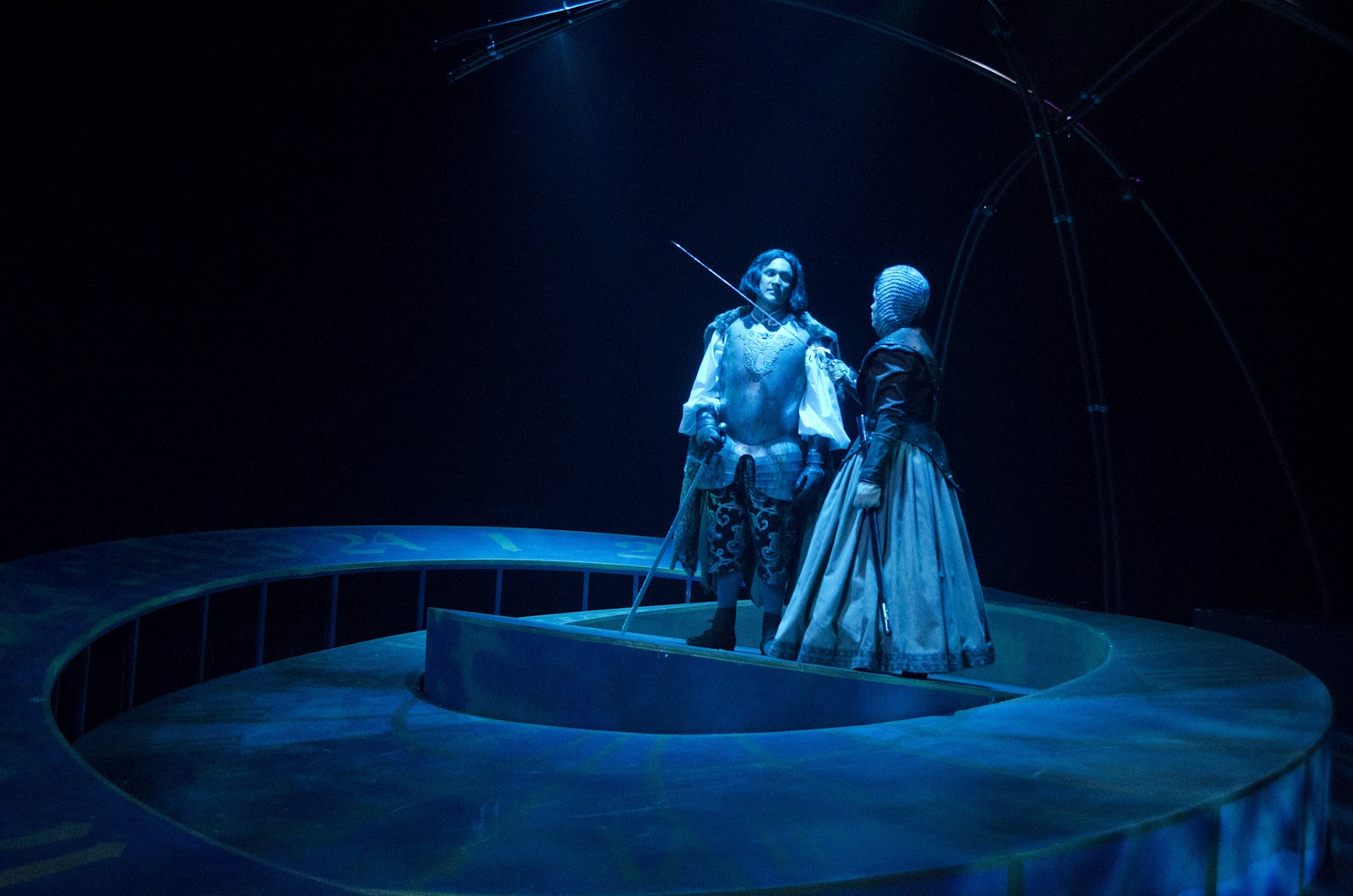
There were three parts to the stage, we gave them pastry terms.  There was the doughnut around the perimeter, the smaller circle from the Prauge clock was the biscotti and the other piece was the croissant.  Originally I wanted all three pieces to revolve, which would have created some interesting engineering, by the way.  We settled for the doughnut and the biscotti to revolve with the croissant being fixed.  Since the stage was going to be raked, each time the turntables were to be moved, it would create a different world for our characters to exist in.  Our concept quickly evolved to say that because of Basilio's actions, which were intended to cheat his fate, the whole world was thrown out of whack, and finally at the end when Sigismundo has his moment of clarity and forgives his father, all the pieces of the world came back to perfect harmony. 

It took a bit of engineering to figure out the turntable within a turntable, but ultimately it worked out and was very effective.  For the ease of the actors and to facilitate the storytelling, we chose to only use one turntable at a time to increase the acting areas until the final battle which was to be the most chaotic.  Then we moved both of them.

Groundplan of the set


There was another aspect of the design which was more important during the design phase but became less important during the execution phase.  I designed an orrery to go around the stage, complete with planetoids here and there.  As this piece evolved through the process it became less and less satisfying to me for a couple of reasons.  Because we set this production in a thrust I had to scale back the orrery for sightlines.  Because of the material I suggested, ABS pipe, it was difficult to get the graceful curves in the orbits of the planets.  If I had this show to do over, I would probably cut the orrery.

The world of the prison

Basilio's palace

Back to the prison

Basilio's throneroom

The battlefield

Will triumphs over fate, the world is restored to order

A Note About the Costumes
The costumes for Life is a Dream were designed by Susan Whitfield.  Susan has been the primary costume designer at Ricks College and later Brigham Young University-Idaho for forty-one years.  This year (2012) she retires.  Over the years she has specialized in period costumes, she does them very well.  Life is a Dream was her last big period show.  I think it was her best work.  I am inspired by the fact that after forty-one years Susan is still doing her best work.  It is amazing that after all that time she is retiring at the peak of her career rather than so many who mark time and rely on tricks for the last ten years of theirs.  Susan, you will be missed.  Susan was honored with an exhibit in the Spori Gallery, Spring Semester 2012.  A photo-essay of that exhibit can be found here.

King Basilio's costume.  My favorite of Susan Whitfield's costumes, all time.
This was a very gratifying production to be involved with.  I am thankful to belong to a department that is focused not only on entertaining the masses but educating them as well.

Production Details
Directed by Richard Clifford
Scene Design by Gary Benson
Costume Design by Susan Whitfield
Lighting Design by Ray Versluys
Technical Director: Ray Versluys
Costume Shop Director: Patty Randall