Showing posts with label theater. Show all posts

Sunday, May 19, 2013

She Loves Me--Actor, Mr. Maraczek

Adam Pingel as Georg and me as Mr. Maraczek in a scene from She Loves Me

She Loves Me, book by Joe Masteroff, lyrics by Sheldon Harnick and music by Jerry Bock, was produced in the Snow Drama Theatre at Brigham Young University-Idaho, Fall Semester, 2008.

Synopsis
The play takes place in Budapest, Hungary in the 1930's at Maraczek's Parfumerie.  The manager, Georg Nowack is a shy man who is currently in a relationship with a woman he has never met, only corresponded with through letters.  Maraczek is encouraging Georg to find a woman and settle down. 
Amalia Balash is a young girl who is looking for a job, and when Georg tells her they are not hiring, she attempts and succeeds in selling an unsellable item with Maraczek and Georg watching.  Maraczek hires her on the spot.  Amalia is in a relationship with a man she has never met, only corresponded with through letters.
Amalia and Georg develop a hostile working relationship.
As time passes through Act I, Maraczek becomes increasingly hostile towards Georg.  No one seems to know the origin of the hostility, but it's obvious Georg can do no right.  There is a "you can't fire me, I quit!" moment and Georg finds himself without a job on the night he is supposed to meet his pen pal.
Maraczek turns everyone out of the parfumerie and meets with the private investigator he has hired to follow his wife.  She has had an affair with one of his employees, but it wasn't Georg as Maraczek had expected.  Instead it was Mr. Kodaly.  Maraczek receives a phone call from his wife who says she will not be home until late because she is visiting a sick relative or friend.  Maraczek knows this is false and decides to take his own life.  He is interrupted by Arpad, the delivery boy and wounds himself instead.
Georg goes to the rendezvous point with his "Dear Friend" and discovers that it is Amalia.  He goes over and sits by her and they fight, as always.  She insults him greatly and he leaves.  The act ends with Amalia waiting for her "Dear Friend" and crying when he doesn't show up.

The second act begins with Maraczek in a hospital bed and Arpad bringing him news.  Georg comes to visit him and Maraczek asks for his forgiveness.  He then promotes Georg and asks him to dismiss Mr. Kodaly.
Georg, upon hearing that Amalia has not come to work because she is ill, pays her a visit.  Heartbroken because she thought her "Dear Friend" had stood her up, she has taken ill.  She believes Georg is there to spy on her and she attempts to get ready for work.  Georg assures her he is there out of kindness and gives her some vanilla ice cream.  He also tells her he saw someone at the rendezvous that must have been her pen pal, but he was old, bald and fat.
Throughout the rest of the act, Georg and Amalia become friends at work and she invites him to come with her to Christmas dinner where she will meet her "Dear Friend" for the first time.  Georg finally reveals that he is "Dear Friend".  Amalia tells him she had hoped he was.  And all is well.

Why I chose to be in this production
I am primarily a designer and a technician, but I believe that anyone who is involved in design or technical theatre ought to find themselves on stage once in awhile.  It's good to remind yourself as a technician what it is like on the other side of the lights.

My Dad had passed away about a year earlier and I wanted to be in a play to honor him.  Dad had been an actor and a director all his life, and he was very good at it.  John Bidwell was the director of She Loves Me, and my Dad had been a primary mentor to him.  John was getting ready to retire from Brigham Young University-Idaho and I thought this was probably my last chance to be directed by someone who had been taught by my Dad.  I asked John if he would consider casting me in this play.  He did and I played the part of Maraczek.  It seems that I am to the point in my life where I am playing old men.  I'm okay with that.

I enjoyed being in this play.  I also enjoyed being a veteran actor with younger actors.  I was very careful to approach my part seriously and to be prepared and focused in rehearsals.  It was also nice to give a generation of students a paradigm shift.  Most of the students at that time didn't know that I have at least some acting chops.  Many of them thought I was only a technician. 

We had a terrific ensemble and I enjoyed every moment I spent in this play.  I was thankful to have had this opportunity.

I had a vintage double breasted, blue pinstripe suit that no longer fit me.  I'm pretty sure it shrunk over the years... I loaned it to Adam Pingel for his part as Georg.  It fit him better than it ever fit me, and when the show was over, I gave it to him. 

Pictures

Maraczek dancing with Georg, reminiscing about his courtship with Mrs. Maraczek.  Trying to convince Georg to find a woman and marry her.  Maraczek sings "Days Gone By."

Maraczek also dancing with Ilona in "Days Gone By."

Maraczek attempting to sell the unsellable item

Maraczek and the cranky customer

Maraczek dressing down Georg

Maraczek and the Private Investigator

Maraczek on the phone with his wife.  Knowing she is lying to him.

Maraczek contemplates suicide

Arpad intervenes

Maraczek in the hospital with the Nurse and Arpad

Arpad trying to convince Maraczek to let him be a salesman to the song, "Try Me"

The end of the song "Try Me"

Maraczek begging forgiveness from Georg

A joyful reunion with Maraczek and company.

Production Details
Directed by John Bidwell
Scene and Lighting Design by Richard Clifford
Costume Design by Susan Whitfield
Mr. Maraczek - Gary Benson
Georg Nowack - Adam Pingel
Amalia Balish - Rose Kiernan
Ilona - Andilyn Jenkins
Arpad -  Matt Zachreson
Sipos - Jordan Judd
Kodaly - Seth Nehring
Angry Customer - Cassie Burton

Tuesday, April 9, 2013

Oklahoma--Scene Design

Show Button for Oklahoma

Oklahoma, by Richard Rodgers and Oscar Hammerstein II was produced Spring Semester, 2007 in the Snow Drama Theatre at Brigham Young University-Idaho.

Synopsis
Oklahoma is widely considered the first modern musical.  It begins with Curly singing, Oh What A Beautiful Morning as he prepares to call on Laurie.  They tease one another in their courtship ritual and Laurey ends up accepting an offer to the box social from Jud Fry, the obsessive farmhand.  She does this to spite Curly.

At the box social, there is an auction for the lunch baskets the girls have made and Curly sells his saddle, his horse and his gun to earn enough money to win Laurey's basket so she will not have to be with Jud. 

At the end of the barn raising and box social, Jud confronts Laurey and she fires him.  He threatens her but finally leaves.  Curly and Laurie marry three weeks later and Jud shows up at the wedding and attempts to kill Curly.  Jud is killed in the process and the justice of the peace who has just performed the wedding proclaims it was self defense.  Curly and Laurey ride off at the end in the pretty little surrey with the fringe on the top.

There are several sub-plots but since this is such a well known piece I will not list them here.

Concept
As the design team met together, we agreed that the concept of Oklahoma would be a hand tinted, sepia toned photograph.  I remembered as a young boy, a lady in our neighborhood, whose husband was a photographer, hand tinted black and white photographs.  I had the privilege of watching her do it one day.  She would mix paint on a dinner plate and then using her finger as a brush she would rub the paint gently on the photograph.  The photos had a soft and nostalgic quality that I have never forgotten.

That meant that the colors of the scenery, costumes and lighting would need to be dulled and faded.

As we discussed the show and the concept, I suggested we create the set in forced perspective to simulate the wide open spaces of Oklahoma.

We decided to do most of the scene changes in front of the audience and it became important to us to show the scene changes in Act I as if the audience was a camera and it was panning across Laurey's property.

To recap, the concept became:
1.  Hand Tinted Photograph
2.  Forced Perspective
3.  Scene Changes Pan

Execution
I drew a set of thumbnail sketches in 1/8" = 1'-0" scale of what I thought our production of Oklahoma ought to look like.  After they were approved, I drew them again in 1/4" = 1'-0" scale.  Because the scene changes were going to be so important, for the first time in my career I storyboarded them.

Thumbnails Act I and first scene change
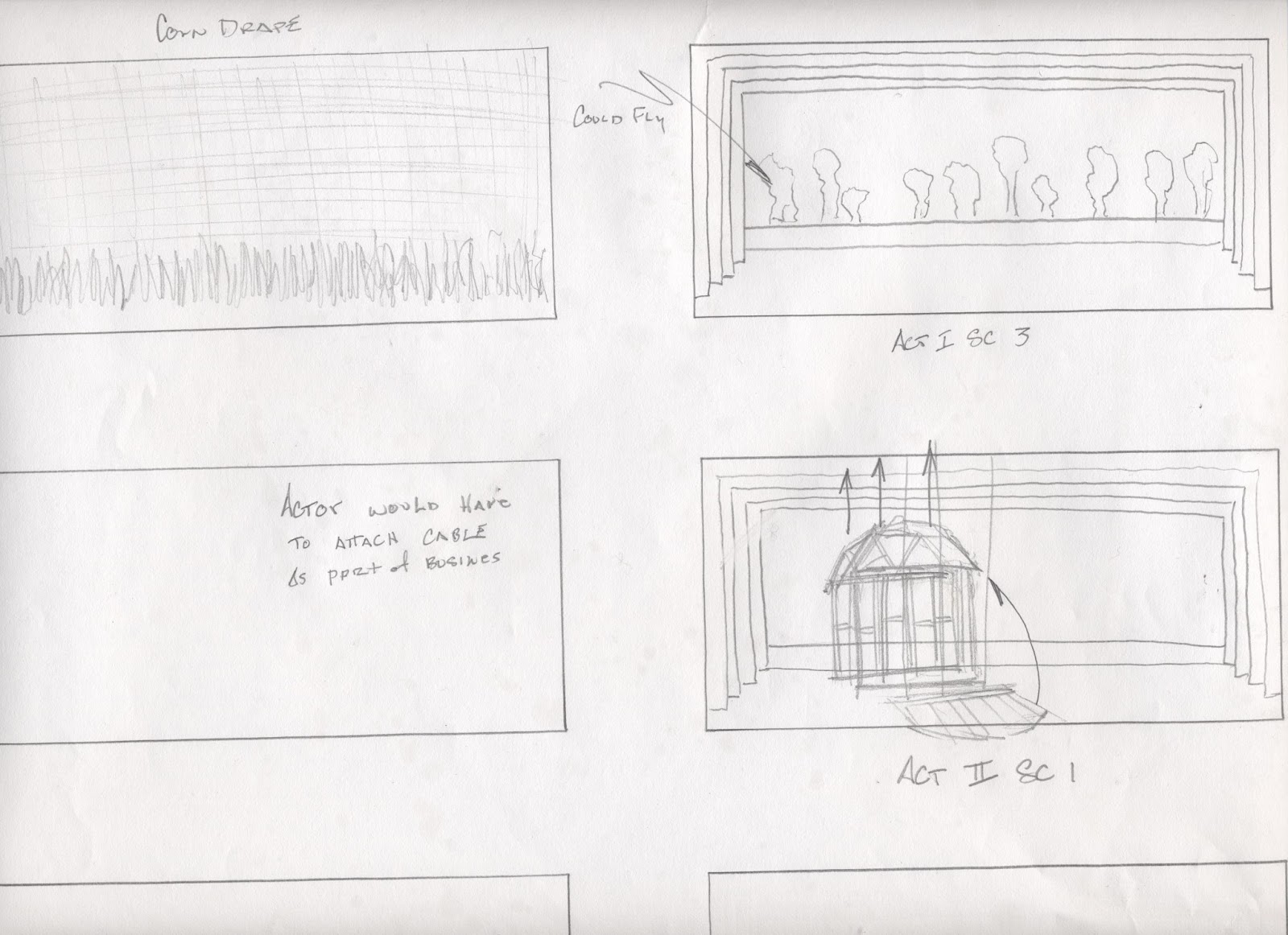
Also idea for corn rig

Thumbnails showing Act I Scene 2 plus scene change
Another idea for a corn rig

More thumbnails for Acts I and II

I decided to use portals to define the space rather than just the black curtains.  I chose portals for both practical and artistic reasons.  Portals are useful in the Snow Drama Theatre because the proscenium is very wide and it is a difficult theatre to mask the backstage area from the audience.  The portals we used were eight feet wide, which we then flanked with the black curtains.

The portals were painted in a sepia tone, but the inside edges were painted in ecru and the border was painted irregularly to abstract the deckled edge of an old photograph.  Each portal was designed to be smaller than the one in front of it as well to establish the forced perspective.

In the original drawings, I had Laurey's house on stage left.  As I worked through the design, I switched it to stage right.  I felt it balanced the picture to place it stage right, plus it facilitated the panning scene changes much better.

Act I Scene 1--Laurey's house

Act I Scene 1

Laurey's house was built in two pieces.  The porch piece detached and exited between portals one and two.  The rear of the house exited behind portal three.  The window up above was practical and Laurie called to Curly from it.  The forced perspective was achieved first by the portals in descending size, and second with the corn.  We created a cornfield by covering a sheet of plywood with blue foam, carving it into rows and "planting corn" in it.  The cornfield moved by embedding inline skate wheels into the plywood to give it a very low profile.  In the back, between the cyc and the scrim we created another cornfield, but the corn on that one was much smaller to simulate that it was in the distance.  There was a small windmill behind the scrim as well.

Full size corn in foreground, small size corn and windmill in the back behind the scrim


Windmill and corn behind scrim and groundrow

The corn by the henhouse

I made the corn by gutting about thirty Tiki torches I had purchased at Big Lots for about a dollar apiece.  I walked the canals and ditches around the countryside for cattail leaves and helped my brother thin his iris and collected those leaves as well.  My students and I then attached the iris and cattail leaves up the bamboo pole with green floral tape, then we created the tassels from floral picks I bought at a Christmas clearance sale and finally painted them with Design Master spray paints.  When the corn was finished, we sleeved it into holes in the blue foam.  The ASM called the corn wagon the giant skateboard.  We happened to have a stuffed raccoon, so I placed it in the cornfield.  Why not?

Rocky Raccoon

Act I Scene 2--The Smokehouse

Act I Scene 2

The Smokehouse set was designed in more extreme forced perspective than the farmhouse.  The walls splayed and the exposed timbers up top were spread like fingers across the stage.  The lighting designer backlit this for great effect.  We covered the walls with a combination of tools and implements and cut-out girly pictures from the Police Gazette.

Because I wished to simulate the camera panning across the property for these scene changes, I designed a window on the stage right side of the smokehouse, on the same wall as Jud's bed, to suggest that Jud would try to look at Laurey's window from his.  Made him that much creepier to me. 

Act I Scene 3--The Grove

Act I Scene 3

The trees turned out to be one of my favorite scenic elements in the play.  Originally, they were supposed to track across the stage during the scene change, but that proved too costly so we flew them instead.  It proved to be a pretty scene change because we had hidden stagehands behind the smokehouse that dragged it off while the trees flew in.

I designed the trees to be flat and flown, and the trunks were two dimensional but painted to appear three dimensional.  I wished the tops of the trees to be textured to catch the light, so we purchased a great deal of silk ficus foliage and stapled it up and covered them.  The lighting designer skimmed them with sidelight and it turned out to be very beautiful.

When Laurey collapsed in the grove, the ballet began and we flew the trees out.  The ballet is a dream sequence and all went to bare stage with a lighted cyc.  At the end, Richard Clifford, the director just wanted the red rag to fly in for intermission.  I requested we add a fly cue and bring the grove back in before the rag flew to re-establish reality for Laurey.  We tried it, we liked it.  I think it was the correct choice.

The Ballet

Act II Scene 1--The Barn Raising

Act II Scene 1

At the top of the act, we saw several of the townsmen with poles, pushing the front section of the barn vertical.  I designed three barn pieces in forced perspective.  The section down front was the largest and each one was successively smaller.  We also found paper lanterns in two sizes and had a string of the larger ones on the second frame and the smaller ones on the third frame.  All contributing to the idea of forced perspective.

Using poles to raise the barn


Act II Scene 2--The Skidmore Ranch

Act II Scene 2

The Skidmore Ranch scene is where Jud swears his love to Laurey who rebuffs him.  Jud grows angry and she fires him.  Curly saves her finally confesses his love to her.  He proposes, she accepts.

This was a simple scene with a corner of the ranch house on stage right with a flower garden wagon (made the same way as the great corn skateboard), a bench and a coal fired stove.  The scene was at night and we flew in a moonbox and a star drop behind the black scrim.

Act II Scene 3--The French Scene

Act II Scene 3

The scene change between the Skidmore Ranch and Laurey's place is the most involved change in the show, and Rodgers and Hammerstein wrote a delightful little scene to facilitate that change.  It involves Ado Annie, Will Parker and Ali Hakim.  It also involves a lot of kissing.

We chose to utilize the French scene as intended and dropped an act curtain in front of the scene change and placed a section of fence in front of it.  When the French scene was finished we raised the act curtain and were back at Laurey's place for the wedding, the death of Jud Fry and the grand finale.

Act II Scene 4--Back at Laurey's place

Act II Scene 4

This scene was much like the scene at the top of the show, except the cornfield was gone and there was different outdoor furniture to facilitate the wedding.  There was a table in front of Laurey's house and another makeshift table for gifts made of planks and crates.

After the death of Jud, Curly is found not guilty by a jury of his peers and he and Laurey ride off in the pretty little surrey with the fringe on the top.  I happened to have a colleague on campus who collects surreys and wagons.  He loaned us one of his for the run of the show. 

The pretty little surrey with the fringe on the top, drawn by six strong men

A few thoughts on scene changes
The original idea or concept for the scene changes was to have the scenes change in full view of the audience magically.  For example, we have a turntable on the Snow Drama Theatre stage and I originally wanted the smokehouse to be dragged into place by the turntable.  I wanted it to begin with the back of the smokehouse to the audience, be dragged into place by cables mounted on the turntable and brought to the front and turned around by the turntable. 

It would have been really spectacular if we had been able to manage that.

I also wished the grove to be dragged across the stage from stage left to stage right as if the camera had continued to pan across the property.

Both of those scene changes would have been costly to do and complicated to engineer.  Add to the fact that the sequence of scenes in act II don't lend themselves to spectacular scene changes and reality set in.  We do not have a Broadway sized budget at BYU-Idaho.

As a designer, I was faced with the decision, "Do I spend my money on the scenes or do I spend my money on the scene changes?"  The answer was obvious.

I enjoyed working on this production of Oklahoma.  We had a great design team and all of us were together on the concept.  This was a true pleasure for me.

Production Details
Directed by Richard Clifford
Scene Design by Gary Benson
Costume Design by Susan Whitfield
Lighting Design by Ray Versluys
Sound Design by Antonia Clifford
Technical Director:  Ray Versluys
Costume Shop Director:  Patty Randall

Saturday, June 30, 2012

Macbeth--Scene Design

Lady Macbeth, hands dripping with Duncan's blood

Macbeth, by William Shakespeare was produced Winter Semester, 2010 in the Snow Black Box Theatre at Brigham Young University-Idaho.

Synopsis
The story of Macbeth is well known.  Macbeth and Banquo, heroes of the Scottish king Duncan happen upon the three weird sisters, witches who tell them that he, Macbeth will become Thane of Cawdor and thereafter king of Scotland.  They tell Banquo he will sire a line of kings but will not attain kingship himself.

Shortly after, a messenger arrives and hails Macbeth as Thane of Cawdor because the previous thane had taken up arms against the king and was sentenced to death.  Macbeth instantly begins to believe the witches and tells his wife about their prophecies.  Lady Macbeth has no reservations about her own ambitions and commands Macbeth to slay Duncan while he is a guest in their castle.

Thus begins Macbeth's descent into murder and madness.  He finds he has to commit many murders to cover up the first.  He is haunted by the ghost of his friend, Banquo whom he also had put to death.  Lady Macbeth does not escape the fate of madness either as she sleepwalks and attempts to rid herself of the blood on her hands.  Lady Macbeth committs suicide rather than live with the guilt.

Macbeth lives with the confidence of the witches prophecy that he will rule until Birnam Wood comes to Dunsinane and that no man born of woman can slay him.  When he realizes that the English army, led by Macduff is advancing on Dunsinane, concealing themselves with hewn boughs from the trees of Birnam Wood he panics.  He still does not believe he can be killed until his final battle with Macduff where it is revealed that Macduff was from his "mother's womb untimely ripped."

Macbeth is beheaded and Malcolm, Duncan's son is placed upon the throne.

Concept
Roger Merrill, the director wanted our production of Macbeth to be both simple and complex.  He wanted the overall design to be austere with little scenery and just a few furniture pieces and changes in light to indicate change of scene.  He also wanted to have trap doors and elevators concealed within the stage to provide entrances and exits for the witches.  He had an idea that the witches would come up on the battlefield through the stage and drag the fallen soldiers through the trapdoors to hell.

We also decided we could tell the story better with a thrust stage.

I suggested that we paint a map of Scotland, on parchment, on the floor with the important placenames indicated.  That way the stage could be wherever we wished it to be.  Somewhere in the discussion the idea of having strips of fabric hanging at the back of the stage as a projection surface was mentioned.  I don't remember who suggested it, either Roger or Richard Clifford, the lighting designer.

There were between twenty and thirty images we wished to project on the fabric strips.  We originally wanted to project charcoal drawn images of each of the castles indicated in the script as well as animations of the spectres and ghosts Macbeth was seeing.  We ran a few animation tests to see if this was a feasable idea and unfortunately it proved too costly and would have required five projectors as well as the purchase of a computer program to integrate and intercut them.  We also did not have the time available to make this a reality even if we'd had the money.  Sadly, we ultimately had to abandon that aspect of the concept.  Richard did make use of the fabric strips as a cyclorama though.

Execution
I made a couple of quick sketches in conté of my impressions of the set from my discussions with the director.  The first sketch was just of the set.  In the second set, I added a witch and a cauldron and tried to be a little more expressive.

First sketch of Macbeth

Second Sketch of Macbeth

The height of the stage became the primary consideration because of the traps and elevators.  I wanted the stage to be as low as possible and still accomodate actors and stage machinery.  Ray Versluys, the technical director said he needed at least four feet from the floor of the Black Box to the top of the deck for the elevators.  The compromise we had to make because of this was to eliminate the row of chairs on the stage floor because of sightline issues. 

Roger wanted the battles to erupt on stage so I added three sets of stairs at the rear of the stage and one set of stairs on the front.  This allowed a great number of people to enter the stage in a very short time.

Ray modified a design for a fast/slow trap which required stage weights, an arbor and a technician underneath the platform to operate it.  The biggest challenge was to reweight the arbors each time the traps were used.  The more weight, the slower the trap.  The witches would walk over their trap and literally disappear into the floor.  At other times they would pop up out of the floor.  That was the fast part of the elevator.  Sometimes they would shrink into the floor.  That was the slow part of the apparatus.  In addition, the elevators needed to be locked when not in use so actors on stage wouldn't inadvertantly fall through the floor.

The witches emerge from the traps

The next major element was the backdrop which I divided into five strips of fabric.  I offset them so three were in the rear and two were in front.  I staggered them in that way to make them easier for actors to enter and exit the stage.  I designed the fabric strips to be abstracted military banners, but with no color or identifying markings.  I also shredded the bottoms of each of them to give more texture to the set.

We painted the banners with washes of raw sienna paint to give them the aged feeling.  Richard lit the banners in different colors depending on the feel of the scene and then added texture with gobos.

Malcolm and army at Dunsinane Wood, texture on the banners

Lady Macbeth and Nurse, different texture on banners

Macbeth and Lady Macbeth, change of color on banners

I researched medieval maps of Scotland for this production of Macbeth and used them for inspiration for designing the floor treatment.  First the scenic artists base coated the floor with an earthy yellow, then spattered and sponged in lighter and darker tones of the yellow to create a parchment effect.  They then created a scale grid on the drawing and laid out a full size grid on the stage and transferred points from one to another and created the outline of the country.  Then they painted the outline with straight burnt umber paint and feathered the insides in so the outside edge would be sharp but the interior of the map would be blended.  Each of the important place names were lettered in with a Celtic script, and lastly, the compass was added along with medieval ship icons and at least one renaissance style sea serpent.

Duncan and vassals on the map of Scotland.  Full stage view

Banquo and Macbeth, map on stage floor

For many of the scenes, we opted to use only lighting to indicate change of location and time.  For others we brought in furniture or props.  We chose which scenes needed more rendering and which ones did not based primarily on length of scene.  The longer scenes required more packaging and by default, the shorter scenes needed no scenery to convey the images and ideas we were striving for.  For some of the scenes, Richard used window gobos to indicate location.  With this convention, in my opinion, the audience was never lost when location was changed.  The biggest benefit to the Spartan use of scenery was that we didn't have to stop the show to render a scene.

Lady Macbeth, "Out damned spot":  Window gobos

Macbeth's meltdown after seeing the ghost of Banquo:  Use of furniture to change location

When we were going to use projections, the idea was to project images of the eight kings from Banquo on the fabric banners and not use a cauldron.  When we discovered that it would be way too cost prohibitive and time consuming to do the animations, Roger decided we should build a cauldron that would fit over one of the traps and would be large enough for the eight kings, Banquo, Macduff and the little boy to come out of.  We pumped fog up through the opening to give it an eerie look.

Banquo exiting the cauldron

I am glad to be in a theatre department that has a committment to producing the classics.  This was a very good production of Macbeth and it was a joy to work on.  I truly have the best job in the world.

Production Details
Directed by Roger Merrill
Fight Choreography by Amelia Bahr
Scene Design by Gary Benson
Costume Design by Susan Whitfield
Lighting Design by Richard Clifford
Sound Design by Antonia Clifford
Technical Director:  Ray Versluys
Costume Shop Director: Patty Randall

Monday, June 18, 2012

A Christmas Carol--Lighting Design

Scrooge eating his evening porridge
A Christmas Carol by Charles Dickens was produced as the last show of Fall Semester, 2006 in the Snow Drama Theatre at Brigham Young University-Idaho

Synopsis
The story of A Christmas Carol is so well known and has become a part of the popular culture that I won't give a detailed synopsis of it here.  I will instead give a short summary.

Ebeneezer Scrooge is a miser, who hates everything about Christmas.  He has a clerk, Bob Cratchit that has been working for him for years for meager wages.  Scrooge routinely turns down any opportunity to celebrate Christmas or donate to any charities.  He insists on calling Christmas a "Humbug".

Scrooge's former partner, Jacob Marley died seven years earlier on Christmas Eve.  As Scrooge is settling down to go to sleep, he is visited by Marley's ghost who is sporting an enormous chain which he describes as the chain he forged in life and tells Scrooge that his own chain was the same as his seven years earlier and has grown larger still.  In an effort to save Scrooge's soul, Marley tells him he will receive three visitors, all ghosts who will show him he was wrong.

The first visitor is the Ghost of Christmas Past.  She shows Scrooge a time when he celebrated Christmas, when he was a more tender soul.  She also shows how he became miserly.

The second visitor is the Ghost of Christmas Present.  Usually played as a jolly giant.  He shows Scrooge how people all over the country celebrate Christmas and then shows him how happy Bob Cratchitt is with his family, even on the meager wage he is paid.  Scrooge is also made aware of Bob's crippled son, Tiny Tim.  Scrooge asks the spirit if Tim will live, and the ghost mocks him with his own words.

The third visitor is the Ghost of Christmas Yet to Come.  This spirit is usually portrayed as the grim reaper, and only gestures but doesn't speak.  This spirit shows Scrooge the Cratchitts without Tiny Tim and finally shows him his own future as a corpse not cared about and later in an untended grave.  This has the desired impact on Scrooge and he vows to change his ways.

The next morning, Scrooge awakes and is giddy, making good on his promise and begins to celebrate Christmas by giving himself and his riches to all the people he had previously foresaken.  He brings Bob in as a partner and vows to find doctors to heal Tiny Tim.  The narrator ends the play by saying Scrooge was "better than his word."

A Christmas Carol is my all time favorite Christmas story.  I'm thankful I had the chance to be a part of this production.

Concept
The first and fifth acts of A Christmas Carol are set in the present and follow a chronology, but the second, third and fouth acts are episodic and scenes change rapidly.  Because of this, the Director, Omar Hansen wanted to make certain that we differentiate the scenes with lighting.  We also decided that since Scrooge existed in a different dimension than the shades he was seeing that he would be lit differently than the other characters in the scenes.  I asked if there were any moments where we could have the actors' faces go into shadow.  Omar said we could, but he wanted to be able to see faces most of the time.  In other words we could do it for effect, not the overriding aesthetic of the whole piece.

Richard Clifford designed a beautiful set that was mostly background elements with a raked stage out front where furniture pieces could be brought in to change location.  There were also a few pieces that were flown, such as windows and Scrooge's apartment building fasçade.  The most striking feature of the set was an enormous working clock which was to be lit from within through most of the show.

Execution
Because the nature of this piece is episodic, and it trends to the supernatural, I chose to light it in the following ways:

Present Day
The scenes set in the present, with no ghostly intervention, I chose to light primarily from the beam positions in the Snow Drama Theatre.  The beams are the catwalks over the audience in the auditorium.  I decided to light the actors in a more realistic fashion, at least the way audiences are used to seeing them, fully lit.  Even so, the lighting was angled slightly so the actors would be more three dimensional than they would with straight on frontlight. 

I chose cool colored lighting for the first act because of how chilly Scrooge's outlook was on life.  This helped sell the fact that Bob Cratchit is cold and has to warm the ink in the well to get it to flow.  There were also a few candles in places which motivated the lighting somewhat.

In the fifth act I chose warmer colors in the light, pinks and ambers to show how the events of the night had softened Scrooge's heart and made him a more sympathetic character.  In both acts I and V, there was a large flown window that had Santa Frost on all the panes.  I backlit the windows to cause them to glow.

Act I cool lighting


Act V warm lighting

Act I Effects Lighting
I picked a teal green gel for anything relating to Jacob Marley, Scrooge's late partner.  When Scrooge goes to his home, the door knocker transforms into the likeness of Marley.  I decided to use the green gel in a pinspot, aimed directly at the knocker as a special to acheive this effect.  I used a ten degree barrel on a source four lighting fixture and that didn't create a small enough circle of light, so we added an iris to the fixture to make the light even smaller. 

Doorknocker special

Just before Marley appeared, Scrooge was eating his porridge and I lit him with a pink sidelight from one direction and a blue one from the other.  The image for is at the beginning of this post.  I wanted to heighten the supernatural aspect of the coming scene and chose to do it in this way.

When the ghost of Jacob Marley finally appeared we choreographed his movements through the scene so he would go to the exact same spot on the same word each night.  That way we could control the light on him.  I used the teal green gel as downlights and we created a cue system that led and followed Marley as he moved through the scene.  The light would slowly come up in front of him and would trail off as he left it, kind of like a spectral trail.  As much as possible, we tried to keep Scrooge out of the spectral light, or at least on the periphery.

There were two moments when Marley roared and we lit the entire stage and out into the audience when he did so.  That cue was a multi-step one that started on him and grew in three or four phases till it filled the auditorium.  Then it trailed back in reverse order.  The Marley cues were among my favorite of the show.

Marley's entrance

Marley descends the stairs

Marley in the light, Scrooge on the periphery

I am Marley, hear me roar!

Act II--The Ghost of Christmas Past
When the Ghost of Christmas Past was introduced in our production, she reminded me of an image from a Maxfield Parrish painting and I decided to use pink for her color initially.  Some of the experiences she chose to show Scrooge reminded him of happier times in his life, as well as some sad memories that give the audience a little insight into his character.  During the happier moments of his childhood, I lit the stage with more of the frontlight but as he became stingier and less likeable, I introduced side light as the primary light source.

  I used warmer light at the first of this act and finally when Scrooge chooses money over the love of his life, I used a very cool blue light from the side.  The color I chose was Lee 202.  Lee is a theatrical Gel manufacturer and 202 is a very icy blue.  It was so blue it almost made the image on stage appear black and white.  I have added it to my pallette ever since this play.

The Ghost of Christmas Past pink entrance light

Warm lighting during the Fezziwig scene


Lee 202 as sidelight

Act III--The Ghost of Christmas Present
The Ghost of Christmas Present is usually portrayed as a jolly giant.  He spoke his first lines offstage into a microphone with some effects layered in.  I used a 9 light directly behind him to give a giant shadow across the stage that would make him larger than life.  Unfortunately, I don't have any images of his entrance.  For the rest of the act, I tried to keep the light on him reasonably warm, and I also tried to keep the lighting on Scrooge and the Ghosts a little different than it was on the shades the ghosts were showing him.  It worked out fine mostly, but Scrooge would go into the scenes with the other characters (as almost all Scrooges do) so he'd be lit with the shades.  Most of the time, though he'd exit that light and go back to the other light when he addressed the ghosts.

 At the end of this ghost's life, when he introduced Ignorance and Want, I used a much cooler light to signify his passing.

Scrooge and the Ghost in different light outside the Cratchitt home

Scrooge in the scene lighting, Ghost on periphery

Ignorance and Want

Act IV--The Ghost of Christmas Yet to Come
The scenes with The Ghost of Christmas Yet to Come were mostly dark and in cool colored lighting.  Even in the Cratchitt home, the light was icy around center stage with some warmer light Stage Left where the fireplace supposedly was.  During these scenes, Scrooge kept his distance as a spectator and stayed on the outside of the circle.

In the graveyard, I used very cool, dark light at the beginning, but as he made his discovery and as he vowed to change, I introduced a lighting effect that I called "the fires of Hell light".  I used a very primary red gel in an instrument that I fitted with a gobo rotator and had two gobos in opposition to one another to create a fire effect that started small and as it gained intensity, it literally filled the stage.  I have still images of this effect but not moving ones, unfortunately.

Scrooge and the spectre outside the light at the Cratchitt home

Scrooge makes a grisly discovery in the cemetery

Scrooge in the Fires of Hell light

Other
The enormous working clock was used as a punctuating device during some scenes.  It became more important as the story went on, getting brighter and brighter, letting us know that Scrooge is running out of time.  The movement was devised by Ray Versluys, our technical director by utilizing different sized pulleys and a belt.  It worked flawlessly throughout the run of the show.  It was a large disk, made of wood with an open front that we covered with muslin and painted transclucently to allow for it to glow.  The light bulbs inside were C-7's, the kind you'd find on an older string of lights for a Christmas Tree.

The clock

I also used sidelight alot in this production.  Probably more than I had ever used it before.  I think to good effect.  Sidelight allowed me to create more dramatic lighting.  For example, lighting from one side allows for part of the actor to descend to shadow.  Lighting from two sides creates very interesting modelling on the faces of the actors.  


Use of sidelight

More use of sidelight


Saturated sidelight at end of Fezziwig's scene

.A Christmas Carol is one of my all time favorite plays.  I've had opportunity to be involved with five different productions of it in my career.  I hope this one is not the last.

Production Details
Directed by James Omar Hansen
Scene Design by Richard Clifford
Lighting Design by Gary Benson
Costume Design by Susan Whitfield
Technical Director:  Ray Versluys
Costme Shop Director:  Patty Randall