Wednesday, May 9, 2012

Phèdre--Costume and Lighting Design

Phèdre cast
Phèdre, by Jean Racine was produced Winter Semester, 2012 in the Snow Black Box Theatre at BYU-Idaho.  Euripedes first treated this material in his play, Hippolytus which was performed in 428 bc.  In 1677 ad, Racine wrote a neo-classical format version of the story and called it Phèdre.  His version introduced a love triangle.  In 2009 a Ted Hughes, free verse translation was produced at the Royal National Theatre in England.  This was the script we used.

Synopsis
Theseus, the king of Athens is missing and presumed dead.  His son, Hippolytus has been living in Troezen as a "jailer" to the Princess Aricia who is the last remaining heir of the royal house Theseus defeated to come to power.  Theseus will not allow her to marry because he believes she will bear a child with a claim on the throne, but he also does not wish to kill her.

Hippolytus confides to his manservant and best friend, Theramenes that he is in love with Aricia and wants to leave because it is in direct conflict with his father's order.  With his father's apparent death, though Hippolytus becomes king of Troezen and resolves to free Aricia of the barbaric law his father set.

Phèdre, enters with her bodyservant, Oenone.  She is very ill and reveals she has been slowly poisoning herself because of some sin she has committed.  Through the scene we learn the sin she is guilty of is being in love with her stepson, Hippolytus.  Oenone convinces her that now Theseus is dead, her love of his son is no longer wrong and she should confess to him.

Hippolytus confesses his love to Aricia when he frees her and tells her he will not seek to press his claim to the throne of Athens but instead would support her claim over Phèdre's son's.  Aricia has been secretly in love with Hippolytus for some time and tells her friend and confidant Ismene.  All seems to be well.

As he tries to take leave of Phèdre, she confesses her love for him and he leaves, horrified.  In the process he leaves his sword behing.  At that moment, Panope, the messenger enters and says that the dead king is not dead and has returned and will be at the palace in a short time.  Phèdre, not wishing to face her shame gives Oenone permission to tell the king whatever she will.

Theseus helm
Theseus returns to a family in disarray.  No one seems at all glad to see him.  He is perplexed and wishes he were back in the dungeon from which he escaped.  Oenone lies and tells him Hippolytus made advances on Phèdre and had attempted to dishonor him.  Her evidence is the sword that Hippolytus left behind when he fled.  Theseus is enraged.

He confronts Hippolytus, who denies any wrongdoing except that he is in love with Aricia against his father's wishes.  Theseus thinks that is a ploy to divert his guilt and calls down a curse against him from Neptune, who incidentally owes him a favor.  Hippolytus leaves.

Phèdre, upon hearing of the curse, confronts Oenone and learns what she has done and casts her out.  Oenone does what any self respecting servant would do in this situation and casts herself off a cliff into the sea.

Hippolytus and Aricia arrange to meet at a shrine later and marry in secret.  They say their goodbyes, and he leaves, resolved to honor his father with his deeds.  Theseus enters and Aricia tells him that she and Hippolytus really do love one another and he was wrong.  Theseus doesn't believe her right away but she has sown the seed of doubt.  He decides to get to the bottom of things and calls for Oenone.  Panope shows up instead and tells him of Oenone's death.

Meanwhile, Theramenes shows up and tells the king in a three page monologue how Neptune struck down his son at his request.  Theramenes is slightly disrespectful to the king and the king takes it, does nothing.  Theramenes tells him his son's last request was for him to restore all things to Aricia.

Finally Phèdre shows up, sick from poison administered by her own hand, confesses everything and dies.  Theseus mourns very loudly and decrees, in accordance with his son's dying wish that all things are restored to Aricia and he adopts her.

Concept
When the director, Hyrum Conrad and I discussed the concept of this play, he said he would really like to do the play in a straightforward way, in Greek dress.  He wanted the world of the play to be more colorful than stereotypical Greek dress.  He was very interested in deep jewel tones.  I suggested we should look to the French neo-classical painters and their conception of Greek dress, since this was a French neo-classic play.

We had just done Oedipus the summer before and Hyrum suggested that he'd like to use costumes from that production to clothe the lesser characters which meant we would build all of Phèdre's costumes, all of Theseus', all of Hippolytus and all of Aricia's costumes.  The rest I would use stock and accessorize differently than they had been used before.

Research
The basic garment worn by the Greeks was called a Chiton which is essentially a rectangular piece of linen wrapped around the body once and fastened with Fibulae (ancient Greek version of a safety pin) over the shoulders and sometimes down the side.  Often the chiton was held in place by a cord or a belt tied at the waist or under the bust.

The chiton was covered in public with a garment called a Himation which was a long rectangular piece of linen that was wrapped in a multitude of ways around the body.  The status of a person was often shown by the size and wrapping of the himation, the greater the status, the more elaborate the garment.

Greeks used to wear a garment called a Chlamys for travel.  A chlamys is a smaller rectangle or square of fabric draped either over or under one arm and fastened over the other shoulder with a fibulae.  A chlamys is kind of like a cape in modern parlance.

When I first began working on this design I remembered several images of the Emperor Napoleon by Andrea Appiani, dressed in Greek or Roman garb and I used these as my starting place.  From there I began researching French Neoclassicist painters, especially the images of what they imagined Greek life to be.  Jacques-Louis David painted many Greek scenes and I found his work very helpful in creating my aesthetic for this show.  I did not limit my research to his work, however.

Among the images I was inspired by were:
  • Anger of Achilles by Jacques-Louis David, 1825
    • Gold painting on red and blue chlamys'
  • The Farewell of Telemachus and Eucharis by Jacques-Louis David, 1818
    • Headband with fringe
    • Gold painting or embroidery on edge of chlamys
    • Fibulae down side of her chiton
    • jewels stitched to her chiton
    • Hairstyles
  • Mars Being Disarmed by Venus and the Three Graces by Jacques-Louis David, 1824.
    • Tassel on headband
    • Gold trim on himation
    • Sandals with top panel
  • Paris and Helen by Jacques-Louis David, 1788
    • Headband
    • Tassels on himation
    • Trim on edges of fabric
    • Hairstyles
  • Oedipus at Colonus by Jean-Antoine Theodore Giroust, 1788
    • Himation draped over woman's head
    • Gold trim on edge of Chiton
    • Sandals
    • Chlamys
    • Headbands
  • Allegorie Relative by Jean-Jacques Lagrenée, 1783
    • Headbands
    • Hairstyles
    • Small Chlamys
  • Romulus' Victory over Acron by Jean-Auguste-Dominique Ingres, 1812
    • Gold laurel wreath crown
    • Red himation with gold trim
    • Large chiton
    • Armor
Execution
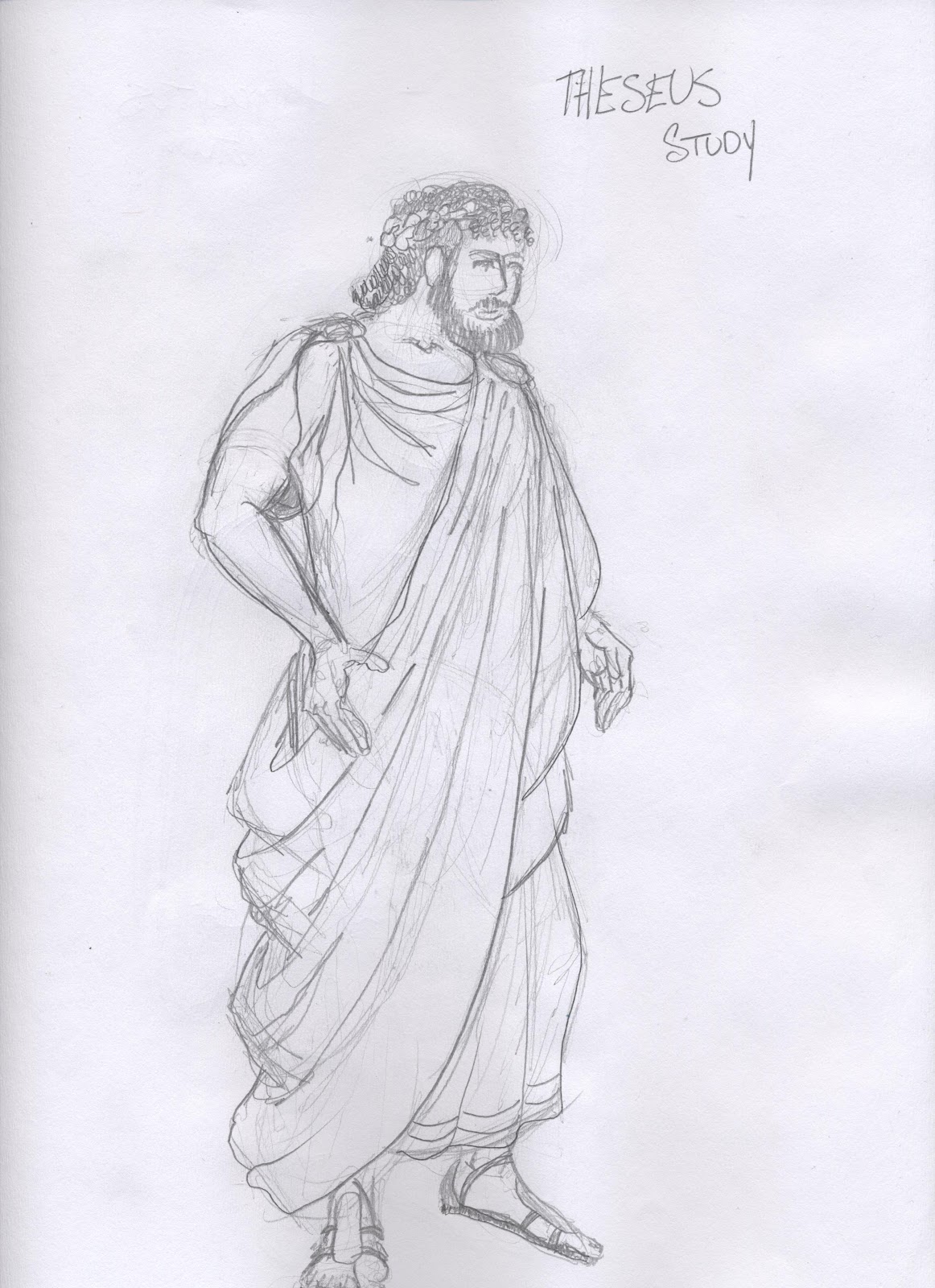
For some reason, I chose to work on Theseus first.  He seemed to be the character that I had the first strong impressions about.  He seemed strong but misguided.  A man prone to make snap decisions which usually works for him but in this case he errs.  I viewed him as larger than life and yet sympathetic.  This is a man who pals around with the gods.  I saw him as a man trying to emulate Heracles and Zeus.  His first entrance has Theseus returning from a 6 month adventure in which everyone thought he had perished.  I wanted to give him an almost feral look so I did a rough sketch of him with a large cat skin as a himation and showed it to Hyrum.  I didn't think he'd go for it but he did.

Quick sketch of Theseus first look
Ultimately we added leather armor, a prop helm and a laurel wreath crown for Theseus and he ended up looking like this.

Theseus first look
For his second scene Hyrum and I decided he would have shed his travelling clothes and gotten dressed in more courtly robes.  This scene is an impassioned one and I chose to make a big statement with a large red himation.  This was his Zeus look and I used the Ingres image as my primary inspiration for his costume.

Quck sketch of Theseus second look
The finished costume looked like this:

Theseus "Zeus" look
We added one more change for Theseus which was just an exchange of the red himation for a neutral one.  That was for Act V when he is in his garden away from courtly things.  I chose a neutral color because I thought it seemed more grounded, less bombastic than red.

Theseus last look
I drew a sketch of Theseus and ended up merging it with another one of Hippolytus to get Hippolytus' Act V costume.

Theseus sketch, adapted and merged with another drawing for Hippolytus
Hippolytus for Act V
The end product looked like this:

Hippolytus and Aricia, Act V
Other costumes in the show:

Hippolytus and Theramenes, Act I
Phèdre and Oenone, Act I
Aricia and Ismene, Act II
Oenone, Phèdre and Hippolytus, Act II
Oenone and Phèdre, Act III.  Phèdre's courtly himation
Panope and Theseus, Act V
Lighting Design
The lighting design for this play was fairly straightforward.  I divided the stage into five areas and four fill areas.  Each area was lit from eight directions with ETC source 4's.  For color shifts I used a combination of Seachangers and color scrollers.  I also used foliage gobos for the exterior scenes and window gobos for the interiors.  Nothing really innovative in the regular light hang.

I took a chance on the downlight, however with very satisfactory results.  We hung three ETC PARNel's above each area, each focused to the exact same spot, one gelled red, one green and one blue.  This allowed me to color mix on the stage rather than using color scrollers.  Scrollers are noisy and if your colors aren't adjacent on the scroll you have to run through colors to get to the one you really want.  That makes them unwieldy when trying to change color rapidly within a scene. 

From the three colors I was able to create white light, amber, cyan, magenta and various shades inbetween just like lighting color theory suggests.  It was a neat effect and I intend to incorporate it into future designs when appropriate.  The effect is visible to a degree in some of the photos above.

I enjoyed the design process and its results in this production.  We paid special attention to character development through costume, which I felt was successful.  I also enjoyed the grand experiment with down lighting. I will use it again.

Production Details
Directed by Hyrum Conrad
Scene Design by Hyrum Conrad
Costume Design by Gary Benson
Lighting Design by Gary Benson
Technical Director: Ray Versluys
Costume Shop Director: Patty Randall

Saturday, May 5, 2012

Rashomon--Lighting Design

The Monk and the baby
Rashomon, by Ryūnosuke Akutagawa was produced Winter Semester, 2008 in the Snow Black Box Theatre at Brigham Young University-Idaho.


Synopsis
The play begins at the Roshomon Gate where a priest, a woodcutter and a commoner are waiting for the rain to stop and they talk about the big news of the day.  A samurai has been discovered, murdered in the forest.  A bandit has been captured and tried for the crime.  The priest and the woodcutter were both called upon to testify in court and they recount the trial to the commoner.

The first witness was the bandit, Tajōmaru who claimed to have overpowered the samurai and seduced the woman.  She begged him to free her husband so that only one man would know her dishonor.  They fought and Tajōmaru won, leaving the samurai dead.  The woman fled.

The second witness was the woman, who claimed that the bandit fled after raping her.  She freed her husband and begged him to restore her honor, but he didn't believe she fought hard enough.  She claimed to black out with her dagger in her hand, but when she awoke, the dagger was firmly planted in the Samurai's chest.

The last witness was the samurai himself who testified with the aid of a spiritual medium.  He claimed that after Tajōmaru had seduced the woman, that she told him to kill her husband so she would not know shame.  Tajōmaru was repelled by this and freed the samurai and left.  The samurai claimed to have committed suicide rather than face his shame.

The woodcutter then claims that the samurai's story was a lie because he had witnessed everything from a hiding place.  He hadn't told the court because he didn't want to get too involved.  According to him, the samurai didn't want to fight Tajōmaru because he didn't want to risk his life for a spoiled woman.  She then castigated him and Tajōmaru and called them cowards.  They decided to fight but neither were very skilled and by accident the samurai is killed.  The woman and the bandit fled in separate directions.

At that moment, the priest, commoner and woodcutter hear the cry of a baby who has been abandoned on the midden heap.  The commoner takes the offerings that were left for the baby and he and the woodcutter fight.  The commoner has deduced that the woodcutter robbed the body of the samurai, so why shouldn't he take from the abandoned baby.  the commoner leaves and the woodcutter confesses to the priest that he robbed the samurai's body to provide for his six children.  Then he offers to take the baby home and raise it as his own.  The priest leaves, no longer despairing for humanity.

Concept
The director, Roger Merrill wanted the priest, the commoner and the woodcutter to be onstage for the entirety of the show, observing the characters as they act out their testimony.  He also wanted to distinguish between the Roshomon Gate, the courtroom and the forest.  The action moves from one location to another fluidly and seamlessly so there was not time for scene changes.  That meant we would need to accomplish most of that with stage lighting.

Execution
I have to say that the scene designer, Richard Clifford gave me a very good canvas to light.  First there was a raised deck about sixteen feet by twenty-two feet with a hanamichi, which is a long ramp in Kabuki theatre which runs through the audience to the stage.  There was another raised deck at the rear of the stage with the Rashomon Gate on it.  The Rashomon Gate had two openings on each side covered with Shoji screens.  Above the set were some distressed, raw silk banners, three of which would come down in front of the gate during the flashback sequences.

Rashomon, set by Richard Clifford
There were three different types of scenes to light for this play.  The first type was a rainy evening in the present with the priest, the commoner and the woodcutter.  The second type of scene were the court scenes where the character would have to testify.  The third type of scene was during the testimony when the action would be played out in front of the audience.  The first decision I made as a lighting designer for this show was to use a haze fog so we could see the shafts of light and provide atmosphere.

For the general light hang, I decided to go against convention and only have one area for the main part of the stage.  Normally a lighting designer would break a space that big up into six or more areas and light each of them separately.  One of the reasons for this was that the electricians who wired the black box theatre only gave us 70 circuits to work with.  I wanted to hit the stage from nine directions didn't have enough circuits to do it with multiple areas.  To do it, I used ETC Source 4 fixtures with 36 degree barrels which spread the light over the whole area.  The problem with that is that there is a finite amount of light coming from an instrument and the wider the beam the dimmer it appears.  To compensate for that, we hung a second instrument to the side of the first and focused it on the exact same spot.  Then we plugged them both into the same circuit with a Twofer.  Essentially we got twice the light on each area by hanging this way.

I wanted quite a bit of texture in the lighting because the majority of the play took place out of doors in a forest.  Originally I wanted to have a breakup gobo in every instrument and we hung it that way at first.  It was too much and I had the electricians remove one gobo from every pair of lights.  When I saw the quality of this light, I remembered something Jules Fischer said in a stage lighting convention I had attended.  He said a lighting designer should "light the shadows."  Originally I had planned to have both lights from each position gelled with the same color filter but when I remembered what Jules said I experimented with different colors and ended up putting a warm color in the light with the gobo and a cool color in the light without. 

What ended up happening was the warm light was more dominant than the cool light so wherever the warm light passed through the gobo it overwhelmed the cool light.  That allowed the cool light to illuminated the shadows without losing the shadow effect.  It worked very well and I ended up adopting it for the whole of the show.

Lighting the shadows.  Scene set in the present
The scenes with the priest, the commoner and the woodcutter were set in the present during a rainstorm at night.  These three men were seeking shelter from the storm and passing time by talking about the death of the samurai and the trial.  For much of this, they huddled around a small firepit that was cut from the stagefloor.  We used a silk flame for this effect.

For these scenes, I used primarily cool, dim, textured light to simulate evening.  I wanted to create a rain effect with light, so we had source 4's aimed at the building with gobo rotators and fixed gobos to achieve it.  It was quite convincing. 

For the trial scenes, I backlit the Shoji screens and we had an actor create a shadow character of a judge or a lawyer behind them while the defendant or the witness was onstage in a harsh colorless downlight.  During the trial scene with the medium, though I did add a downlight with a gobo rotator to make her scene just a little more mystical.

Tajōmaru on trial
The wife as a witness
The medium testifies on behalf of the slain samurai
For each of the different re-enactment scenes, I designed a different quality of lighting.  In the bandit's tale, I backlit the Shoji screens with yellow light and a masculine, angular breakup gobo.  I backlit the silk banners above the set with a foliage breakup gobo and green gelled light as well.  The dominant lighting color during this scene was amber, with blue light filling the shadows.  I wanted the quality of light to reflect the character of the bandit, as a braggart.

The bandit's tale
For the wife's tale, I chose a softer approach.  The light behind the Shoji screens was a salmon pink and the gobos were very delicate.  The primary lighting color during this scene was pink to reflect the feminine aspects of her character.

The wife's story
For the samurai's tale as told through the medium, we decided to have the lighting be mysterious.  I used a different gobo in the Shoji screen lights and also used color scrollers to change the lighting color through the blues, greens and yellows during the scene.  I wanted the screens to be different from each other in this scene to convey the mystical nature of the spiritualist.  At the end of the scene we brought the medium back into the harsh downlight of the trial and had her pantomime the self murder of the samurai while he also performed the act behind the three silk banners over the gate.  I lit the banners with yellow light and what I called my dagger gobo.  Inside the gate where the samurai was I used a red downlight.

The samurai's tale as told by the medium
Death of the samurai
For the woodcutter's tale, the scene designer dropped green ribbons from the grid to the stage floor to represent a bamboo forest.  The director and I decided that this tale was the most reliable one because it was told from a third party so we lit the scene as brightly as possible.  As I'd write the cue and show it to Roger he'd ask, "Can we make it brighter?"  I lit the Shoji screens in this scene with a nice green light and streaky gobos set in the same direction as the ribbons in the bamboo forest.

The woodcutter's tale
At the end of the play, after the commoner has left, the woodcutter takes the baby from the priest to raise along with his own children.  The priest now has a more positive outlook on life because of the woodcutter's selfless action.  He exited on the hanamichi and I lit him with backlight primarily to give him a halo effect and just enough frontlight to warm his face.

The priest exits on the hanamichi
I enjoyed working on this show.  I felt we had a very positive collaborative relationship and created something praiseworthy.  All aspects of design were pleasing and the performances and direction were very good as well.  This was a good production.

Production Details
Directed by Roger Merrill
Lighting Design by Gary Benson
Scene Design by Richard Clifford
Costume Design by Susan Whitfield
Technical Director:  Ray Versluys
Costume Shop Director:  Patty Randall

Tuesday, May 1, 2012

The Magic Flute--Costume Design

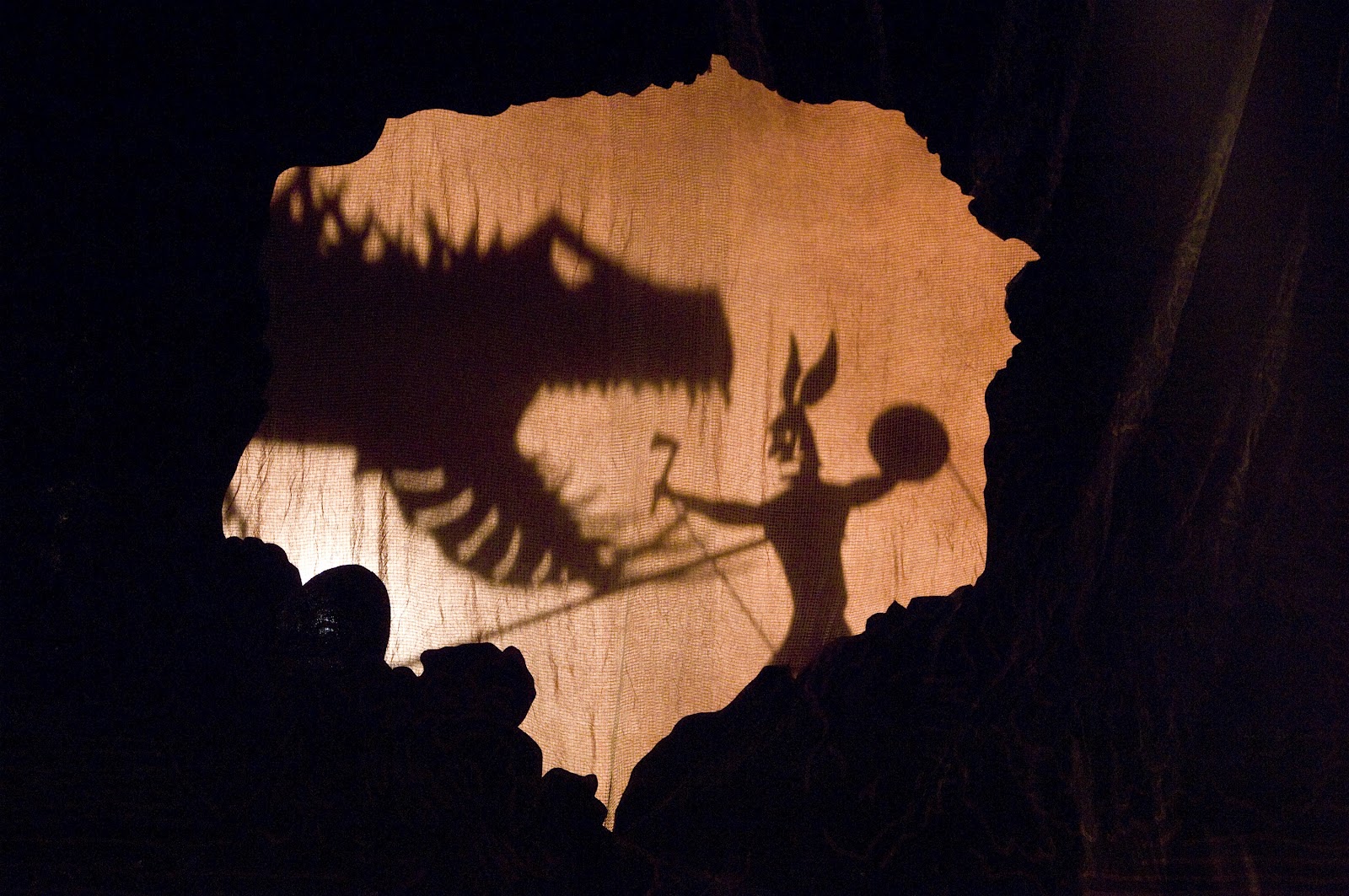
Shadow puppets designed by Carl Day
The Magic Flute, by Wolfgang Amadeus Mozart was produced at Brigham Young University-Idaho, Winter Semester, 2008 on the Snow Drama Theatre Stage.

Synopsis
Tamino, a prince from a distant land is battling a serpent.  Overcome with fatigue he faints and as he is about to be killed, the three ladies who are servants to the Queen of the Night slay the serpent and rescue him.  When he comes to, they show him a picture of Pamina with whom he falls madly in love.  The Queen of the Night appears and pleads with Tamino to rescue her daughter from the evil Sarastro.  He agrees, and with his new found trusty sidekick Papageno, the birdman, he sets out to find her and free her from bondage.

On his journey, however it is revealed that the Queen of the Night is the evil one and Sarastro is the benevolent one.  In order to become a modern man, and win the hand of Pamina, Tamino must pass through a number of trials.  Papageno also finds his soulmate, the beautiful birdgirl Papagena.  Finally, when Tamino and Pamina have passed through the trials of fire and water, the Queen of the Night and her evil henchman Monostatos are vanquished and the two are married.

Concept
This production was co-directed by Jon Linford of the BYU-Idaho Music Department and John Bidwell of the BYU-Idaho Theatre Department.  Jon suggested the concept that when European strength and vitality met Eastern sophistication and philosophy, the Renaissance was born.

We discussed what this meant at some length and determined that our hero, Tamino would be a northern barbarian who would slowly transform throughout the opera until he became a "modern" man.

Execution
We had a very talented young costume design student named Julie Brown that was trying to beef up a portfolio so she could apply to graduate school.  I agreed to take her on as an assistant designer for this show.  Julie was very good and so I decided she should be more of an associate designer and I gave her Pamina and the three spirits, as well as many of the chorus members to design.  She did a wonderful job on those costumes.  As part of the agreement, though since I was the designer of record, I retained right of approval on her costumes.  I do not feel that I abused that authority, however.

One challenge we had was the fact that many of the roles were double cast.  Tamino and Pamina, the Queen of the Night, and Papagena were all double cast.  Of all the characters, only the actresses who played Pamina were the same size.  For example, one of the queens of the night was at least six inches taller than the other.  So we had to build double costumes in some cases and find creative solutions in others.

As I was pondering the role of Tamino, I recalled an album cover of a 1970's southern rock band named Molly Hatchet.  It had a barbarian carrying a battleaxe and wearing a winged helm  This was my initial inspiration for his character.  I also really liked the fact that I could inject a little Rock and Roll into an opera.  Afterall, Mozart, in my opinion, was a rockstar in his day. 

I viewed Tamino as a Viking and dressed him in a blue tunic with an animal skin cape, breeches with cross gartered boots and the feathered helm.  I also had a student and good friend, Robert McKenzie build a Scottish targe for him.  In addition to that I bought him a bearded axe.

Tamino in battle dress with axe and targe
Tamino vanquished, with helm and targe
The transformation of Tamino began in the first scene when the three ladies remove his helm, take his axe and targe. 

The transformation begins
As Tamino grew more and more civilized, he lost more and more of the northern barbarian look and became more refined.  After the weapons and armor were taken, the next step of the transformation was the animal skin cloak.

Tamino continued to change, sporting neatly coifed, dark hair in an 18th century style, no mustache, and wearing penitent's robes

Tamino in penitent's robes
Finally, when he has passed all Sorastro's tests, Tamino is transformed into a modern Renaissance man in full 18th century regalia.  I found a piece of upholstery fabric at Home Fabrics in Idaho Falls, Idaho that was a blue chenille with a great gold thread design.  I knew it had to be Tamino's suit.  We also covered his tri-corn hat with it.

Tamino's suit
(promo shot)

Pamina, Sarastro and Tamino as the newly enlightened
Sarastro was played by the great Norman Bailey, who celebrated his 75th birthday by coming out of retirement to play the role.  Sarastro's tunic and robes were also made of upholstery fabric and his hat was actually a fur covered band hat that we refurbished and wrapped with linen.

The Queen of the Night was an interesting challenge to design.  The first time we see her we need to identify with her because we believe she is an injured mother who only wants the return of her daughter.  The second time we meet her we realize that she is the embodiment of pure evil.  In addition to this she must be at all times spectacular.

I decided she should be in full 18th century costume with the underdress, paniers and an overdress.  I also cheated just a little and gave her an Elizabethan standing collar in black boned lace.  I designed an enormous hooded cape for her out of sheer purple and blue organza which she kept on for the entirety of her first entrance.  The cape hid the sinister, 18th century horned goddes wig that we styled. 

I found a dark purple tafetta with a swag design which we turned upside down and cut out the bottom row of swags which gave it a batwing design.  This I backed with a pleated black satin ruffle about nine inches long.  The overdress was constructed out of a black chenille with gold thread and trimmed in purple.  Finally, the hood was large and the cape was 20 feet long by 15 feet wide.  The edges were cut with a batwing profile and made sturdy by sewing tie-line in the hem.  We also had wooden rods for her hands to hold the cape out at different moments of the aria.

I found some pointy witch shoes online and finished the costume by adding about a hundred dollars of colorless acrylic gems to all parts of the costume, including her earrings, shoes and wig. 

Her first entrance was stunning.  She had her back to the audience and was in total darkness.  The front of the stage was lit so we barely saw her silhouette against the black star drop.  The cape was spread out over the stairs and when the lights bled up over the stage it was breathtaking.  She turned and delivered her first aria without removing the hood or the cape.  On her second aria she was without the hood and we saw the horned wig for the first time and through costume realized she was evil

Unfortunately, someone released the spotlight crew on picture call night so we don't have images with the correct lighting in many cases.  That's a shame as it was a beautiful lighting design.

The Queen of the Night
More the Queen of the Night
Can't get enought of the Queen of the Night
The horned goddess wig
(promo shot)
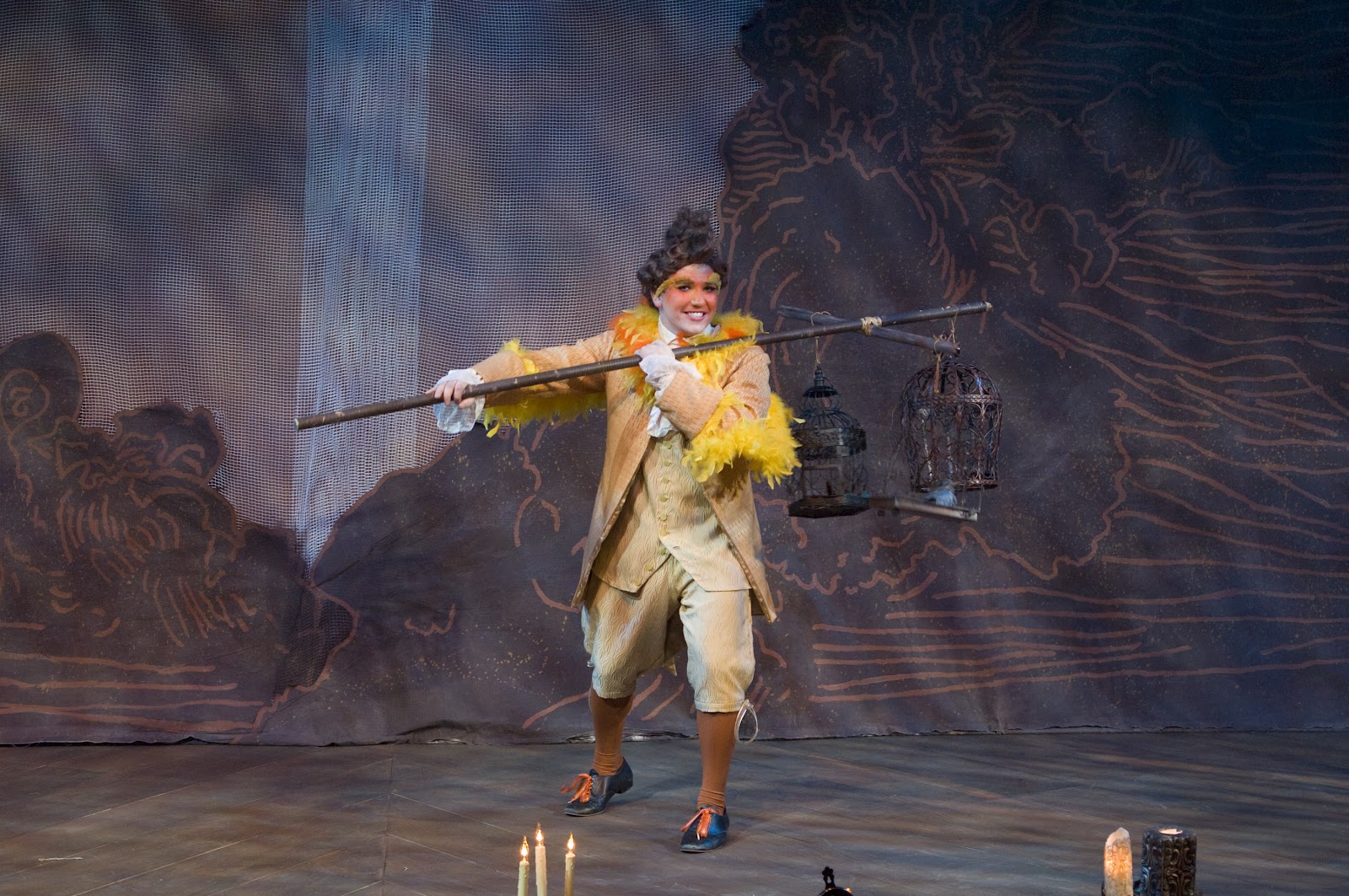
I decided to use alot of feathers for the bird people, Papageno and Papagena.  I also decided to color coordinate them as they would be in nature.  Yellow and orange seemed appropriate to me, possibly because canaries are harmless and their only purpose in life is to sing and be delightful.  I viewed Papageno and Papagena in that way.

I asked Lindsay Lopez to design their makeup and requested that she incorporate ostrich plumes into their eyebrows.  I also asked Celeste Harper to style the wigs.  She styled an 18th century wig for Papageno which abracted a coxcomb on top and an 18th century ladies wig for Papagena with ostrich plumes woven throughout.

Papageno was dressed in traditional 18th century garb except that he tended to sprout yellow and orange feathers from the seams in his jacket.  He also had a yellow and orange collar made of a feather boa.  Papageno also sported a shaved ostrich plume tail.

Papageno
Papagena comes to Papageno disguised as an old hag.  He has to prove himself to her before she is revealed as the beautiful bird girl.  I told Patty Randall, the costume shop director that I wanted Papagena to be able to begin as the old hag, turn around one time and be revealed as the beautiful bird girl, complete with an ostrich plume tail.  But I didn't want anyone to assist her and I didn't want any fabric from the old hag left on stage.  In other words I wanted magic.

If we had allowed an assitant or allowed fabric to be left on stage it would have been easy.  All we would have had to do is remove a cloak and voila she would be revealed.  I didn't want anything that easy.  I wanted the hag costume to melt away and the bird girl to appear.  I wanted jaws to drop.

Patty is a very gifted pattern maker and came up with a solution to this impossible problem almost without any hesitation.  It involved Papagena getting dressed in her bird girl costume, then lifting everything up and stepping into the hag costume but tied at the waist and pulled up to conceal the pretty costume.  Then we added witch gloves which were long opera gloves dyed grey with witch fingertips glued to the fingers.

Papagena would say her last lines as the hag while carefully pulling her fingers out of the gloves, then she would turn around and part the hag robe with her hands and gravity did the rest.  The transformation was spectacular.  The old crone literally melted away and Papagena appeared and the audience had a collective jaw drop every night.  And there was no fabric left behind.  Magic.

Papageno and the Hag
Papageno and Papagena
For Monostatos, I pulled his costume primarily from stock.  A piece from one show, another piece from a different one and so on.  Where I really had fun with his costume, though was in the accessories.  I made him a heavy beaded necklace with imitation human vertabrae and finger bones tied into it.  I braided bones into his hair and bought a massive shamshir (curved sword).  I also gave him a "ZZ Top" style beard as another homage to Rock and Roll.

Monostatos
The Two Armed Men were fun costumes to create.  I went back to my high school days and the first costume I ever designed to create them.  I was cast as the 4th Knight in Once Upon a Mattress and complained to my teacher that I needed armor if I was going to be a knight.  He said I'd have to build it myself and suggesed I make it out of milk jugs.  Long story short, I did and it turned out great, both in high school and in The Magic Flute.  I credit that high school experience as the one that really got me on the path to being a designer

I rented helmets for the two armed men and decorated them with coque feathers.  We had some old vacuum formed scale armor breastplates that I used, and then I outfitted them with heavy knit thermal underwear that was dyed grey, then I cut out armor pieces out of milk jugs and plastic soda bottles.  We painted them and stitched them to the thermal underwear.

The gauntlets, though were the best part.  I bought grey cotton knit gloves and cut out finger armor from the handles on the milk jugs and then stitched the handles to the fingers on the gloves.  I've used that on Halloween costumes for my boys as well.  It's a really great way to get cool armor cheap.

I finished the costumes off with high boots and breeches from costume stock.  The final touch and my last homage to Rock Music were the rockstar wigs I put on these two men.

Two armed men in "milk jug armor"
Julie's designs for this show were very good.  She clothed Pamina in a blue-green tafetta gown with a sheer organza veil.  Both the gown and the veil were embroidered.  She looked stunning.

Pamina's gown
Jon Linford, the co-director said he wanted the Three Spirits to look like Mozart as a child.  The Three Spirits are pants roles for women, by the way.  Julie designed these wonderful skirted vests and frocks for them, each in a different color.  I felt they were missing something because they were supposed to be spirits and yet they were really grounded in reality.  I happened upon a 1908 lithograph for the original Le Chevalier D'Eon which showed in the bottom left corner, a child wearing 18th century garb but with insect wings.  I knew we had several sets of Victoria's Secret style angel wings and knew it was the right thing to add.  I had to convince Julie of this but I think she was okay with it by the end.  The wings didn't obscure any of the costumes she had designed, they just gave the Three Spirits just enough whimsy to suggest they were from a different world.

To my knowledge that is the only alteration I made to any of Julie's designs.

The Three Spirits
We have done several biblical shows over the years and we have a great deal of biblical costumes in stock.  We used these to outfit the priestly chorus.

The Priestly Chorus
I had never been a fan of opera before this one.  Jon Linford has an enthusiasm for the medium that is infectious, though.  This opera was a true joy to work on.  Satisfying in every way.  The collaboration of the whole design team worked very well.  Since this experience, I've given opera another chance and have enjoyed the other three I've worked on since. 

Production Details
  • Directed by Jon Linford and John Bidwell
  • Costume Design by Gary Benson
  • Associate Costume Designer:  Julie Brown Hogge
  • Scene Design by Richard Clifford
  • Lighting Design by Brent Prichett
  • Costume Shop Director:  Patty Randall
  • Technical Director:  Ray Versluys

Saturday, April 28, 2012

The Taming of the Shrew--Scene Design

All is well
The Taming of the Shrew, by William Shakespeare was produced at Brigham Young University-Idaho on the Snow Drama Theatre stage, Fall Semester, 2007

Synopsis
Signor Baptista has a problem.  He has two daughters of marriageable age, the young desirable Bianca and the older, shrewish Katherina.  Baptista has sworn not to allow Bianca to marry until a husband is found for Kate.  No one in Padua wishes to be married to Kate because her temper is notorious.  Bianca has no lack of suitors, including Hortensio, Gremio and Lucentio.  Hortensio and Lucentio pose as tutors in disguise, unbeknownst to Baptista and each other so they may secretly woo Bianca. 

Meanwhile, Petruchio has arrived in Padua from the country with the purpose of finding a rich wife.  His old friend, Hortensio hears of this and recruits him to court Katherina.  Petruchio agrees and the courtship begins.  Petruchio uses reverse psychology on Kate calling good bad and bad good.  She agrees to marry him and at the wedding, he shows up in a strange outfit where nothing matches, acts drunk, threatens the crowd, punches the parson and takes Kate back to his home.

When they arrive, he won't allow her to eat because the meat has been burned and isn't fit for a woman as beautiful as she.  He won't let her sleep because the bed is not worthy of her.  He has a dressmaker bring a beautiful gown for her which she loves but he shreds it in front of her because it was too plain for someone as beautiful as she.  This is his process for "taming" her. 

Back in Padua, Lucentio and Bianca have secretly eloped and there are some delightful scenes involving disguise and discovery.  Petruchio and Kate come back to Padua for a visit and meet Lucentio's father on the road.  Petruchio refers to him as a woman and Kate agrees.  He says the sun is the moon to which she also agrees.  This is evidence to him that she is truly tamed. 

At Baptista's house, Hortensio has married a rich widow, and Lucentio has married Bianca.  Petruchio, Lucentio and Hortensio make a wager as to who has the better wife.  The test is for the wife to get the husband a drink.  Bianca and the rich widow both refuse but Katherine obeys.  Then she scolds the other two women and condemns them for not serving their husbands.  That provokes Petruchio to utter the famous line, "Why, there's a wench, come on, and kiss me Kate".

This play is still controversial after more than 400 years.

Concept
Because this is a small cast show, Hyrum Conrad, the director wanted me to shrink the playing area of the stage.  At the same time, he wanted me to show the wide open vistas of the Itallian countryside.  He also wished to use the turntable with multiple levels to show the different locations.

The play has multiple locations, both interior and exterior and we wanted the scene changes to be quick so as not to interrupt the flow of the play.

Execution
I decided to use portals of descending size to shrink the stage around the turntable.  The effect was similar to the acoustical shell at The Hollywood Bowl.  I didn't want that to get claustrophobic for the audience, though so I found a photograph of the Itallian countryside and we painted a drop at the rear of the stage, then projected the image forward on each of the portals in kind of an exploded view.  This allowed me to shrink and expand the stage at the same time.


Portals.  Scene:  Meeting Lucentio's father on the road to Padua
Hollywood Bowl Image  Link
We decided very early in the process to use the turntable primarily for interior scenes and to use the space in front of the turntable for the exterior scenes.  The portals would also be lit for the exterior scenes and not for the interiors.  We held to this convention with few exceptions. 


Inside Baptista's home
Lucentio and Hortensio wooing Bianca in her budoir
Interior of Petruchio's house. 
Trees and windows flown.
For the exterior scenes in Padua, I designed tracked wagons with the leading edge curved to fit the turntable.  These wagons were situated in between the portals.  The wagons had inline, fixed casters to facilitate them moving in and out without deviation from their course.  The stage crew dressed the wagons with doors and other objects while backstage.  In addition to the doors, we also flew windows in.

We had three different looks.  We had marble painted doors and windows for the scenes in front of Baptista's house, a different set for Hortensio's house and a third for Lucentio's house.  We also had a rooftop piece that flew in during several scenes.


Street in front of Baptista's house
Street in front of Hortensio's house
Street in front of Lucentio's house, Pedant in the window
The convention worked very well and we were able to conduct our scene changes very efficiently.  This was a delightful show.  I am gratified to have had the opportunity to work on it.

Production Details
  • Directed by Hyrum Conrad
  • Scene Design by Gary Benson
  • Costume Design by Susan Whitfield
  • Lighting Design by Richard Clifford
  • Technical Director:  Ray Versluys
  • Costume Shop Director:  Patty Randall